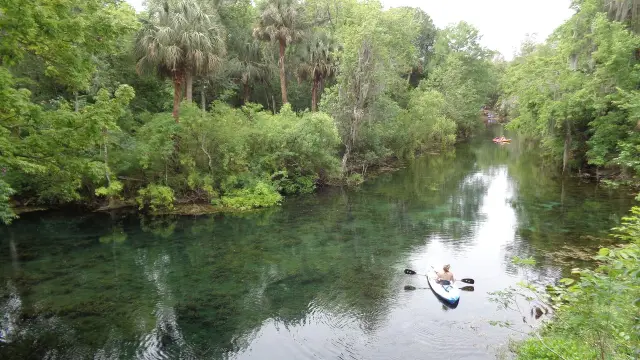
Short answer: Blue Cypress Lake is a 6,555-acre lake in western Indian River County, the largest in the county that also includes Sebastian, and the headwaters of the 310-mile St. Johns River. It is ringed by cypress with over 200 osprey nests, holds largemouth bass and black crappie, and is reached through the county's Middleton's Fish Camp Park on Blue Cypress Lake Rd. and St. Johns River Water Management District land.
Last verified: October 11, 2026, against the sources listed at the end of this page.
What is Blue Cypress Lake?
Blue Cypress Lake is a 6,555-acre cypress-ringed lake in western Indian River County, the largest lake in the county and the source of the St. Johns River.
FWC gives the acreage and describes a shoreline of cypress and spatterdock (FWC). Indian River County calls it a ten-square-mile lake and the origin of the St. John's River (Indian River County). The St. Johns Riverkeeper places the start of the 310-mile river on Blue Cypress Lake about 30 miles west of Vero Beach, and notes that the upper river has indistinct banks and no main channel (St. Johns Riverkeeper).
For Sebastian, the lake is the far western edge of home county. Sebastian sits on the Indian River Lagoon, a separate estuary, while Blue Cypress Lake feeds the St. Johns River system. The two water systems meet in county politics more than in geography: the same Indian River County Commission that sets rules on the lagoon side voted the biosolids moratorium that protects the lake.
Why is Blue Cypress Lake called the headwaters of the St. Johns River?
Blue Cypress Lake is the first open lake of the St. Johns River, and the St. Johns River Water Management District manages the marshes around it as the Blue Cypress Conservation Area.
The District lists Blue Cypress Lake and Kenansville Lake on the western side of the conservation area, which belongs to the Upper St. Johns River Basin Project carried out with the U.S. Army Corps of Engineers. The project is now in long-term maintenance and is meant to reduce flooding, restore natural water cycles and protect water quality. One stated purpose ties it directly to Sebastian's side of the county: it reduces freshwater diversions to the Indian River Lagoon estuary. The District describes the area as one of the most undisturbed in the headwaters, with the largest remnant marsh of its type in the region and an intact sawgrass marsh on the eastern side of Blue Cypress Lake (St. Johns River Water Management District).
Indian River County added land in 2011. With a $1 million grant under the North American Wetlands Conservation Act, the county bought 350 acres of cypress wetland and upland with about 4,700 feet of shoreline on the northwest edge of the lake from Pressley Ranch. The Conservation Fund negotiated the sale, and the county's only expense was $30,000 for that work. A county environmental planner told commissioners that nearly all the land west of the lake counts as headwaters of the river, and that the tract would be reached mainly by boat (Vero News, 2011).
What wildlife lives at Blue Cypress Lake?
Blue Cypress Lake is best known for ospreys, with Indian River County reporting over 200 osprey nests along the shoreline, plus bald eagles, alligators and wading birds.
The ospreys nest in the cypress standing in open water. Vero News described the trees as 130 feet tall in 2025 and listed ospreys, alligators and bald eagles among the lake's wildlife (Vero News, 2025). The county's park page calls the lake a top osprey nesting site and names bass, catfish and alligators along with the birds (Indian River County).
The marsh on the District land supports a longer bird list. The St. Johns River Water Management District identifies foraging and nesting habitat for the snail kite in the eastern portion, along with great blue herons, white ibis, snowy egrets, limpkins, night herons, wood storks, ospreys and bald eagles (St. Johns River Water Management District). Wood storks and ospreys on that list are also familiar birds over the Indian River Lagoon at Sebastian, while the snail kite habitat is specific to the marsh.
What fish are caught in Blue Cypress Lake?
FWC describes Blue Cypress Lake as having a good population of largemouth bass, bluegill, redear sunfish, black crappie and catfish, with buoy-marked fish attractors in open water.
| Species | Where FWC points anglers | Baits FWC lists |
|---|---|---|
| Largemouth bass | Outside edges of grass and offshore cypress; Big M and Zigzag Canals; mouths of Padget Branch, Blue Cypress Creek and Big M Canal | Plastic worms, topwater, crankbaits, spinnerbaits, golden shiners |
| Bluegill and redear sunfish | Grass lines and outside cypress in 1 to 3 feet of water | Small jigs, spinners, crickets, grass shrimp, worms |
| Black crappie | Deeper areas, trolled or drifted; grass and brush lines in the canals | Small jigs, beetle spins, live minnows |
| Catfish | Listed among resident species | Not specified |
FWC's TrophyCatch tracker, which rewards anglers for documenting and releasing bass of 8 pounds or more, lists 12 Lunker Club bass of 8 to 9.9 pounds submitted from Lake Blue Cypress. The forecast notes that bass move shallow to spawn as the water cools in October and November, and it directs anglers to Middleton's Fish Camp for daily conditions (FWC). Indian River County calls the lake a premier location in Florida for largemouth bass (Indian River County). For Sebastian anglers, it is the largest freshwater fishery in Indian River County.
How is Blue Cypress Lake reached, and what are the rules?
The public way onto Blue Cypress Lake is Middleton's Fish Camp Park, a 23-acre Indian River County park at 7400 Blue Cypress Lake Rd. with two boat ramps and a floating dock.
The county lists boating, kayaking and canoeing, fishing, birding, hiking and restrooms with showers at Middleton's. Swimming is prohibited there, as are smoking, fireworks and dumping, under the posted park rules (Indian River County). The surrounding Water Management District land has its own access points and a network of primitive campsites, and the District permits wildlife viewing, seasonal hunting, bicycling and hiking along many miles of levees. Airboat tours run from the 512 Recreation Area by appointment with independent vendors, and the L-77 West Levee area, also called Lake Garcia, is an idle speed zone (St. Johns River Water Management District).
| Site | Manager | What it offers |
|---|---|---|
| Middleton's Fish Camp Park, 7400 Blue Cypress Lake Rd. | Indian River County | 23 acres, two boat ramps, floating dock, primitive camping |
| 512 Rec Pad (Blue Cypress Recreation Area) | SJRWMD | Access point; airboat tours by appointment |
| Fellsmere Grade Recreation Area (Stick Marsh) | SJRWMD | Access point to the conservation area |
| Fishermans Shelter, North Camp, Winter N Camp, Whistling Tree, Garcia and Banjo camps | SJRWMD | Designated primitive campsites and shelters |
The 512 in the Blue Cypress Recreation Area's name is the route number of County Road 512, the same road that runs through Sebastian and Fellsmere.
Why did Blue Cypress Lake water quality become an Indian River County issue?
A 2018 blue-green algae bloom on Blue Cypress Lake led Indian River County to ban Class B biosolids, treated sewage spread as fertilizer, and the county has renewed that moratorium since.
The sequence is documented in Vero News. On July 12, 2018 the Florida Department of Environmental Protection ordered a 180-day stop to biosolids dumping at Pressley Ranch near the lake while it studied nutrient sources with the Water Management District (Vero News, July 2018). That month the county commission banned hauling and spreading of Class B biosolids on unincorporated land for six months, and Fellsmere moved to adopt the same rule, which would make the whole county biosolid-free because no other city in the county had farms using the material (Vero News, August 2018).
The county's study, by Jones Edmunds and Associates, reported in December 2018 that biosolids were the pollution source and that phosphorus in the lake had climbed sharply. Vero News traced the shift to a 2012 state ban on biosolids in the Lake Okeechobee, St. Lucie and Caloosahatchee watersheds, after which more of the material flowed north into Indian River County (Vero News, December 2018). The commission extended the moratorium to January 2021 (Vero News, 2020) and voted unanimously in December 2022 to extend it again; CBS12 reported that state law bars permanent bans but allows existing moratoriums to be extended (CBS12).
Monitoring of Blue Cypress Lake continues. Vero News reported that the Florida Department of Environmental Protection collected a water sample on May 15, 2025 at the 10-square mile lake and found a blue-green algae bloom, and that local officials advised visitors to stay out of water where a bloom is visible (Vero News, 2025).
Frequently asked questions
How big is Blue Cypress Lake?
FWC lists Blue Cypress Lake at 6,555 acres, and Indian River County describes it as about ten square miles, making it the largest lake in the county that includes Sebastian, Fellsmere and Vero Beach.
Can people swim in Blue Cypress Lake at Middleton's Fish Camp?
No. Indian River County lists No Swimming among the posted rules at Middleton's Fish Camp Park, along with bans on smoking, fireworks and dumping. Boating, paddling, fishing and birding are the listed uses.
How many ospreys nest at Blue Cypress Lake?
Indian River County reports over 200 osprey nests along the Blue Cypress Lake shoreline, many in cypress trees standing in the water, which Vero News described in 2025 as reaching 130 feet tall.
Is the Indian River County biosolids ban still in place?
The county first banned Class B biosolids in July 2018 after a bloom on Blue Cypress Lake and has extended the moratorium since, including a unanimous vote in December 2022 reported by CBS12. State law allows extensions but not a permanent ban.
Who manages the land around Blue Cypress Lake?
The St. Johns River Water Management District manages the Blue Cypress Conservation Area around the lake, Indian River County runs Middleton's Fish Camp Park and a 350-acre tract bought in 2011, and FWC manages the fishery.
Sources
- Middleton's Fish Camp Park (Indian River County) https://indianriver.gov/business_detail_T21_R74.php Used for: park size, address, ramps, dock, rules; lake as largest in county, ten square miles, origin of the St. Johns, over 200 osprey nests
- Lake Blue Cypress fishing site and forecast (FWC) https://myfwc.com/fishing/freshwater/sites-forecasts/ne/lake-blue-cypress/ Used for: 6,555 acres, fish species, fish attractors, canals and creeks, TrophyCatch count
- Blue Cypress Conservation Area (St. Johns River Water Management District) https://www.sjrwmd.com/lands/recreation/blue-cypress/ Used for: Upper St. Johns River Basin Project, marsh, wildlife, recreation, access areas, campsites, idle speed zone
- Upper Basin: Headwaters of the St. Johns River (St. Johns Riverkeeper) https://stjohnsriverkeeper.org/about-us/our-river/upper-basin-headwaters/ Used for: 310-mile river begins at Blue Cypress Lake, about 30 miles west of Vero Beach
- County protects 350 acres pristine nature near Blue Cypress Lake (Vero News, August 17, 2011) https://veronews.info/?p=54591 Used for: 2011 county purchase on northwest shore
- Toxic algae bloom detected at Blue Cypress Lake (Vero News, May 22, 2025) https://veronews.info/2025/05/22/toxic-algae-bloom-detected-at-blue-cypress-lake/ Used for: May 15, 2025 sample, 130-foot cypress, wildlife and fish list
- DEP orders halt on biosolid dumping at ranch near Blue Cypress Lake (Vero News, July 14, 2018) https://veronews.info/?p=30044 Used for: July 12, 2018 DEP letter, 180-day halt
- County passes six-month moratorium on biosolids (Vero News, August 2, 2018) https://veronews.info/?p=31167 Used for: county six-month Class B ban and Fellsmere action
- Regulatory disconnect at state level factor in pollution at Blue Cypress Lake (Vero News, December 27, 2018) https://veronews.info/?p=97894 Used for: study linking biosolids to lake phosphorus; 2012 South Florida ban
- County extends ban on human waste as fertilizer (Vero News, July 4, 2020) https://veronews.info/?p=135856 Used for: moratorium extended to January 2021; 2018 microcystin bloom
- Indian River County Commissioners vote to continue biosolid ban (CBS12, December 27, 2022) https://int.cbs12.com/news/local/protecting-our-water-indian-river-county-commissioners-vote-to-continue-biosolid-ban-december-27-2022 Used for: December 2022 unanimous extension, state law on moratoriums