Short answer: The Grove Museum is a free Florida Department of State museum in the ca. 1840 Call-Collins House, less than one mile north of the State Capitol in Tallahassee. Enslaved craftspeople built it for territorial Governor Richard Keith Call; Governor LeRoy Collins and Mary Call Collins bought it in 1942 and sold it to the state in 1985. After a 2009 to 2017 conversion it opened as a museum on March 11, 2017.
Last verified: October 18, 2026, against the sources listed at the end of this page.
What is The Grove Museum?
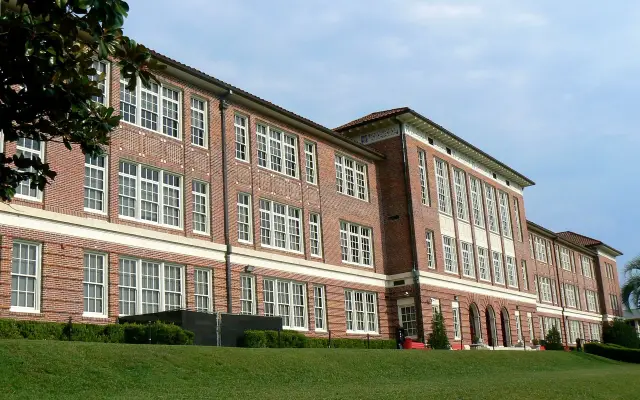
The Grove Museum is the Florida Department of State house museum in the Call-Collins House, a masonry home of about 1840 on 10.5 acres in Tallahassee.
The museum describes the house, built by enslaved craftspeople, as one of the best preserved antebellum residences in Florida, and says the site was listed on the National Register of Historic Places in 1972. Visitor parking is at 902 North Monroe Street. The Department of State, in its August 3, 2017 release, places the 10.5 wooded acres less than one mile north of Florida's State Capitol, while the museum's archaeology page puts the just over ten acres one mile north of the Capitol. The museum is administered by the Department of State's Division of Historical Resources, with support from the Friends of Florida History.
Its subject is wider than one Tallahassee family. The museum's stated mission is to preserve and interpret the house, its acreage and its collections to engage the public in dialogue about civil rights and American history, and its guided tours focus on slavery and civil rights through the lens of The Grove and its former residents. The property passed through several generations of the Call and Collins families, most recently LeRoy and Mary Call Collins, before the Department of State opened it to the public in 2017.
Who built The Grove, and when?
Enslaved craftspeople built the house at The Grove for Richard Keith Call, starting in the mid-to-late 1830s and finishing about 1840, according to the museum.
The museum's Call biography says Call served on Andrew Jackson's personal staff during the First Seminole War, represented Florida in Congress from 1823 to 1825, and moved to Tallahassee with his wife and ten enslaved people after their 1824 marriage. In 1825 the Calls bought The Grove property, originally 640 acres just north of Tallahassee. Call served two terms as territorial governor, 1836 to 1839 and 1841 to 1844, and as receiver in the federal land office he acquired parcels throughout north Florida.
The museum's brick analysis says the oldest bricks on site, locally produced and installed by enslaved brick masons, date from the 1830s, and that by the early 1840s Call owned a steam-powered brick press and at least five brick kilns containing 200,000 bricks each. In the 1830s and 1840s, enslaved people owned by Call and his partners developed the Port of St. Marks, Port Leon, the Tallahassee-St. Marks Railroad and plantations at Orchard Pond and Lake Jackson. When he died in 1862, Call willed 197 enslaved people to his surviving daughters.
Call opposed secession, and The Grove became the stage for it. On January 10, 1861, after Florida's secession convention voted to leave the Union, delegates walked from the State Capitol to The Grove to taunt him, and the museum records that he reportedly told them they had opened the gates of hell. He died at The Grove on September 14, 1862.
Who lived at The Grove between Call and Collins?
Call's daughter Ellen Call Long and her granddaughter Reinette Long Hunt held The Grove from 1851 until Hunt's death in 1940.
Ellen Call Long received The Grove, then 190 acres, from her father in 1851 and lived there until her death in 1905; deeds from her father in 1851 and 1853 also included about 60 enslaved people who lived and worked at The Grove and at Orchard Pond plantation. She represented Florida at expositions including the 1876 Centennial in Philadelphia and the 1893 Chicago World's Fair, raised silkworms, spoke and published on forestry, and published Florida Breezes in 1883, a work of historical fiction that received a mostly negative response, in part because of her Unionist views. Financial hardship forced land sales, and by 1887 The Grove contained only 13 of its original 640 acres.
Reinette Long Hunt acquired The Grove shortly before her grandmother's death and, apart from several years before World War I when renters occupied the house, lived there until 1940. The museum records that the first Tallahassee Country Club organized at The Grove in 1908 before moving to its location near Myers Park, that Hunt operated The Grove as a hotel from the 1920s, and that in 1924 she hosted thousands of Tallahassee residents on the grounds for her play A Historical Pageant of Tallahassee. She also built rental cottages north of the house; the Burr Cottage, the last of them, now holds staff offices.
How is LeRoy Collins connected to The Grove?
State Senator LeRoy Collins and his wife, Mary Call Collins, a great-granddaughter of Richard Keith Call, bought The Grove in 1942.
Mary Call had grown up in the Brevard family home on Monroe Street, just south of the property, according to the museum's Collins history. The family worked to restore the house through the 1940s and 1950s and built an addition on the rear in 1952 to provide modern conveniences.
Collins became Florida's 33rd governor on January 4, 1955. The family briefly lived in the original Governor's Mansion, which the state demolished in 1955, and the Collinses influenced the choice to design its replacement as a nod to Andrew Jackson's Hermitage; the new mansion was completed in 1957. In the late 1950s and early 1960s, while the Collinses lived in Washington, D.C., Colonial Williamsburg curator James Cogar leased The Grove and opened it to the public as a museum.
The house also carries Collins's civil rights record. The museum traces his move from defending segregation to a March 1960 statewide televised address in which he called segregation morally wrong and urged dialogue after sit-in demonstrations in Tallahassee. As director of the federal Community Relations Service, he went to Selma, Alabama, in March 1965 for President Johnson, and a photograph of him beside civil rights leaders there was used against him in his 1968 U.S. Senate race, which he lost.
After that race the couple returned to Tallahassee, where LeRoy Collins served on the 1977 Florida Constitution Revision Commission and Mary Call Collins lent her energy and name to the efforts to save the Union Bank building and the Old Capitol from destruction, the museum notes. The bank now serves as a satellite facility of the Southeast Regional Black Archives, managed by Florida A&M University, and the Old Capitol houses the Florida Historic Capitol Museum.
How did The Grove become a museum?
The Collinses sold The Grove to the state in 1985 with a life estate, and the Department of State converted it into a public museum between 2009 and 2017.
The museum's preservation history says the couple lived at The Grove until their deaths in 1991 and 2009. The work ran in three phases with MLD Architects and Allstate Construction: new storm shutters first, then from 2011 a structural assessment, new footings, an elevator inside the 1950s addition, and masonry repair using clay and mortar similar to the original mixtures. Excavation for the elevator pit revealed brick-lined trenches leading to an original cistern; the archaeology page lists military dog tags, glassware, ceramics and toys among the artifacts recovered from it, and the cistern now feeds the irrigation system.
The museum opened on March 11, 2017, with a free community event, the Department of State announced, joined by partners including Goodwood Museum and Gardens, the John G. Riley Center and Museum, the Knott House Museum, Mission San Luis, the Tallahassee Museum and the Meek-Eaton Black Archives at FAMU. The project then collected the recognitions below, as listed in the Department of State's August 2017 release.
| Year | Recognition | Awarded by |
|---|---|---|
| 2016 | Merit Award of Excellence for Historic Preservation/Restoration | American Institute of Architects, Florida/Caribbean Chapter |
| 2016 | LEED Certification | United States Green Building Council |
| 2017 | Outstanding Achievement in the Field of Green Buildings | Florida Trust for Historic Preservation |
| 2017 | Tallahassee/Leon County Historic Preservation Award of Excellence for Civic/Community Resource Preservation | Tallahassee Trust for Historic Preservation |
| 2017 | People's Choice Award, 2 million of more than 5 million votes among 41 contenders | American Institute of Architects, Florida/Caribbean Chapter |
When is The Grove Museum open?
The Grove Museum house and grounds are open Wednesday through Saturday, 10 a.m. to 4 p.m., with free general admission, according to the Department of State and the museum.
The Department of State museum page and the museum list the Tallahassee site's visiting details below. Well-behaved dogs on leashes may visit the grounds during open hours, and picnic tables are available on a first come, first served basis.
| Item | As posted |
|---|---|
| Open days and hours | Wednesday through Saturday, 10:00 a.m. to 4:00 p.m. |
| Closed | Sunday, Monday and Tuesday |
| House tours | On the hour starting at 10 a.m.; last tour at 3 p.m. |
| General admission | Free |
| Groups of ten or more | $1.00 per guest, arranged in advance |
| Visitor parking | 902 North Monroe Street, Tallahassee, Florida 32303 |
Last verified: October 18, 2026, by rereading The Grove Museum visit, history, preservation and archaeology pages, the Department of State's page for The Grove, and its March and August 2017 press releases.
Frequently asked questions
Where is The Grove Museum in Tallahassee?
Visitor parking for The Grove Museum is at 902 North Monroe Street. The Department of State places its 10.5 wooded acres less than one mile north of Florida's State Capitol.
Is The Grove Museum free?
Yes. General admission is free, according to the Department of State and the museum, and guided house tours run on the hour Wednesday through Saturday. Groups of ten or more can arrange tours in advance for $1.00 per guest.
Why is it called the Call-Collins House?
The house was built for territorial Governor Richard Keith Call around 1840 and later owned by his great-granddaughter Mary Call Collins and her husband, Governor LeRoy Collins, who bought it in 1942 and sold it to the state in 1985.
Who owned The Grove before the Collins family?
After Call, his daughter Ellen Call Long owned it from 1851 until her death in 1905, and her granddaughter Reinette Long Hunt lived there until 1940, running it as a hotel from the 1920s, the museum records.
Are dogs allowed at The Grove Museum?
Well-behaved dogs on leashes may visit the grounds during open hours, according to the Department of State page for The Grove, and picnic tables are available on a first come, first served basis.
Sources
- The Grove Museum (Florida Department of State) https://www.thegrovemuseum.com/ Used for: mission, ca. 1840 house, 1972 National Register, 10.5 acres, 2017 opening, hours, admission
- Richard Keith Call, The Grove Museum https://www.thegrovemuseum.com/learn/history/call/ Used for: Call biography, construction by enslaved craftspeople, 1861 secession confrontation
- Ellen Call Long, The Grove Museum https://www.thegrovemuseum.com/learn/history/ellen/ Used for: Ellen Call Long, 1851 deed, expositions, acreage by 1887
- Reinette Long Hunt, The Grove Museum https://www.thegrovemuseum.com/learn/history/reinette/ Used for: 1908 country club, hotel, 1924 pageant
- LeRoy and Mary Call Collins, The Grove Museum https://www.thegrovemuseum.com/learn/history/collins/ Used for: 1942 purchase, governorship, Governor's Mansion, first museum, civil rights, 1985 sale
- Historic Preservation, The Grove Museum https://www.thegrovemuseum.com/learn/preservation/ Used for: 2009 to 2017 rehabilitation phases, LEED
- Archaeology, The Grove Museum https://www.thegrovemuseum.com/learn/archaeology/ Used for: location, cemetery, brick analysis
- Secretary Detzner Announces Grand Opening of The Grove Museum on Saturday, March 11 (Florida Department of State, March 10, 2017) https://dos.fl.gov/communications/press-releases/2017/secretary-detzner-announces-grand-opening-of-the-grove-museum-on-saturday-march-11/ Used for: opening date and partners
- Call-Collins House at The Grove Wins 2017 People's Choice Award (Florida Department of State, Aug. 3, 2017) https://dos.fl.gov/communications/press-releases/2017/call-collins-house-at-the-grove-wins-2017-people-s-choice-award-from-florida-chapter-of-american-institute-of-architects/ Used for: awards, LEED, location less than a mile north of the Capitol
- The Grove (Florida Department of State, Division of Historical Resources) https://dos.fl.gov/historical/museums/the-grove/ Used for: hours, parking, grounds
How this page was made
Digital Towns uses AI assistance to research and write its guides, and every page is only as good as the sources it cites. Our goal is the most accurate, useful local information possible.
This page was fact-checked twice before publishing.
If you see an error, or anything you can show is false, tell us right away and we will take a third look.
Report an error
Thank you. We'll take a third look and correct the page if it's wrong.