Short answer: Frenchtown is a historic African American neighborhood just northwest of downtown Tallahassee, north of Tennessee Street. A state marker says freed people settled it after the Civil War; city plans record its churches, the Red Bird Cafe, the 1948 Tookes Hotel and Lincoln High School. It lies in the Greater Frenchtown/Southside redevelopment district the city created in 1998.
Last verified: October 18, 2026, against the sources listed at the end of this page.
What and where is Frenchtown?
Frenchtown is a historic African American neighborhood just northwest of downtown Tallahassee, north of Tennessee Street and north of the Florida State University campus.
The neighborhood has no official boundary, and two City of Tallahassee plans draw it differently. The Frenchtown Placemaking Plan prepared by the Tallahassee-Leon County Planning Department says residents tend to agree the historic area runs from Tennessee Street to Brevard Street and from Copeland Street to Bronough Street. The later Frenchtown Neighborhood First Plan records that residents reached consensus on a larger area, and says those boundaries are slightly different from the ones used in other Frenchtown planning processes.
| Side | Placemaking Plan (historic area) | Neighborhood First Plan |
|---|---|---|
| South | Tennessee Street (Placemaking Plan) | Tennessee Street (Neighborhood First Plan) |
| North | Brevard Street (Placemaking Plan) | 7th Avenue (Neighborhood First Plan) |
| West | Copeland Street (Placemaking Plan) | Woodward Avenue (Neighborhood First Plan) |
| East | Bronough Street (Placemaking Plan) | Adams Street (Neighborhood First Plan) |
The Neighborhood First Plan places Frenchtown north of Florida State University, east of the Griffin Heights neighborhood and south of the Levy Park neighborhood, and inside the Greater Frenchtown/Southside CRA District. The Placemaking Plan describes Frenchtown in its prime as a robust African American community with multiple businesses and activities, a cultural center for Black residents of Tallahassee and the location of important events during the Civil Rights Movement.
How did Frenchtown become a center of Black life in Tallahassee?
Frenchtown was settled by freed people after the Civil War and grew into a vibrant African American area, according to a state historical marker in the neighborhood.
The 2013 Taylor House marker at 442 West Georgia Street calls Frenchtown one of Tallahassee's most historic neighborhoods. The house was built in 1894 by educator Lewis Washington Taylor and Lucretia McPherson Taylor, family members lived there until 1977, and it was restored in 2001 and became a museum. The Placemaking Plan adds that Frenchtown was settled largely by Black residents in two waves, first by freed slaves after the Civil War and then by former tenant farmers in the 1910s and 1920s as area plantations converted from farming to hunting.
The same Tallahassee plan's timeline marks the institutions that followed. The table below lists the entries it gives.
| Year | Entry |
|---|---|
| 1867 | Area first referenced as Frenchtown (Placemaking Plan) |
| 1868 to 1873 | Bethel Missionary Baptist, Bethel AME and St. Mary's Primitive Baptist churches established (Placemaking Plan) |
| 1877 | Masonic Lodge established (Placemaking Plan) |
| About 1910 | Knights of Pythias Hall, later the Red Bird Cafe, built; it became a stop on the Chitlin' Circuit (Placemaking Plan) |
| 1946 | Ashmore's Drugstore established (Placemaking Plan) |
| 1948 | Tookes Hotel opens for Black visitors who could not lodge at segregated establishments (Placemaking Plan) |
| 1956 to 1964 | The African American community's struggle for equality gains significant momentum (Placemaking Plan) |
| 1998 to 1999 | Greater Frenchtown/Southside CRA and the CRA established; Frenchtown designated a Front Porch Community (Placemaking Plan) |
| 2017 | City Commission directs a placemaking plan for Frenchtown (Placemaking Plan) |
The plan names Ray Charles, Little Richard and Al Green among the musicians the Red Bird hosted, and lists the Red Bird site at Macomb and Virginia streets among Frenchtown's special places that no longer exist, along with the Leon Movie Theater and the Chicken Shack on Macomb Street. Places on the same list without that note include the Masonic Lodge on Macomb Street, Ashmore's Drug Store at Macomb and Brevard streets and the Goodbread Houses in the 700 to 900 blocks of North Macomb Street.
Why is it called Frenchtown?
The Placemaking Plan ties the name to the Lafayette Land Grant, though it says Frenchtown was settled largely by Black residents.
The Frenchtown Placemaking Plan timeline opens with the Lafayette Land Grant of 1824, which gave the Marquis de Lafayette a township in the United States and which the plan calls the beginning of Historic Frenchtown. It lists 1840 as the year the area became a French enclave and 1867 as the first reference to the name Frenchtown. In its section on Frenchtown's houses, the plan says that although evidence exists that French immigrants established the area in the 1840s and 1850s, the neighborhood was settled largely by Black residents, and its homes, small saddlebag and shotgun houses among them, draw from Black vernacular building traditions.
What became of Old Lincoln High School?
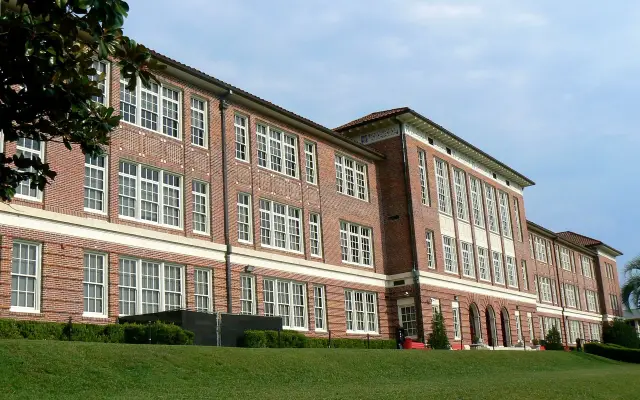
The Old Lincoln High School building at 438 West Brevard Street is now the City of Tallahassee's Lincoln Center, which houses the Lincoln Room museum to the school.
The 2016 state Original Lincoln High School marker says Lincoln was established in 1869 as one of only two Freedman's Bureau schools in Florida and was named for President Abraham Lincoln. The first building, at Lafayette and Copeland streets, burned in 1872. When the second building, at Copeland Street and Park Avenue, was transferred to the Florida State College for Women in 1906, a wood frame school was built at this Frenchtown site, and in 1929 it was replaced by the present brick building, with some funding from the Julius Rosenwald Foundation. Students came from more than 40 schools in rural Leon County and surrounding areas, and there were no buses for African American students until the 1950s.
The official end dates differ. The marker says Lincoln served Leon County's African Americans from 1869 to 1969 and that the Lincoln name moved to the Griffin Middle School site for two years so students could receive Lincoln diplomas until 1969. The City of Tallahassee Lincoln Center page gives 1869 to 1970, and the Placemaking Plan says Lincoln High School closed in 1968 as school segregation ended.
Today the Tallahassee Lincoln Center is open Monday through Friday, 8 a.m. to 5:30 p.m., phone 850-891-4180. It runs an afterschool program for grades K to 8, a six-week summer enrichment program with The Lincoln Foundation and The Riley House, senior classes, and rentals of a conference center for up to 74 people and a gymnatorium seating up to 250.
How does the CRA fund redevelopment in Greater Frenchtown?
The City of Tallahassee Community Redevelopment Agency funds projects in the Greater Frenchtown/Southside district with tax increment money that can only be used within the district.
The CRA says the agency was created in August 1998, its board is the Mayor and the four City Commissioners, and the City Commission adopted the Greater Frenchtown/Southside Community Redevelopment Plan and trust fund in June 2000. The CRA lists the current Greater Frenchtown/Southside Redevelopment Plan as adopted March 24, 2021, and names Frenchtown among its Neighborhood First neighborhoods with Greater Bond, Griffin Heights and Providence.
Two CRA pages describe the district differently. The About page gives 1,858 acres in three distinct sections and a nine-member Citizens Advisory Committee, including two non-voting members. The older Frenchtown/Southside overview page gives over 1,450 acres and describes a seven-member committee, and says the area includes thirteen neighborhood communities and seven major commercial areas and borders parts of FAMU and FSU. The overview page records that the CRA Board approved the Greater Frenchtown/Southside Investment Plan on September 24, 2015, and gave a $125,000 grant to the Frenchtown Community Development Corporation for the half-acre Tish Byrd Community Garden in the Carolina Oaks neighborhood.
For businesses, the CRA project funding page lists a Facade Assistance and Community Enhancement grant matching 50 percent of eligible exterior costs up to $10,000, a Commercial Property Improvement Program of up to $200,000 per parcel, and case-by-case New Construction Assistance. Greater Frenchtown/Southside grant requests above $25,000 go to the GFS Citizen Advisory Committee before the CRA board; the Tallahassee CRA office is at 850-891-8357.
What is the Frenchtown Neighborhood First Plan?
It is a resident-led plan for Frenchtown that the City of Tallahassee's Neighborhood Affairs Division began facilitating in January 2020.
The city's Frenchtown Neighborhood First page says a resident-led Community Action Team and three Priority Area Teams oversaw the process, and that residents identified six priority areas: housing; economic development and community reinvestment; land use and transportation; placemaking and neighborhood image; neighborhood safety; and health and resident empowerment. Its Frenchtown Housing Rehab Program, funded by the CRA, is a five-year forgivable loan of up to $25,000 for owner-occupied units and up to $17,500 for renter-occupied units, and a Frenchtown Community Engagement Fund gives grants to residents and stakeholders who carry out parts of the plan.
The plan is frank about displacement. It says that in the early 1990s several homes on Copeland, Carolina and Georgia streets were demolished and residents displaced to build Carter Howell Strong Park, a regional stormwater facility built to address flooding, and that several businesses along Macomb Street were demolished and replaced with student housing and office uses. Its Frenchtown budget lists $1,000,000 for developing 507 W. Brevard, the old Ashmore's building, for community benefit, $400,000 for improvements to Carter Howell Strong Park and $210,000 for additional historical markers to continue the heritage trail.
Last verified: October 18, 2026, by reading the Frenchtown Placemaking and Neighborhood First plans, the city's Neighborhood First page, three CRA pages, the Lincoln Center page and the Lincoln and Taylor House marker records through src-text.
Frequently asked questions
Where exactly is Frenchtown in Tallahassee?
Just northwest of downtown and north of Tennessee Street. The Placemaking Plan describes the historic area as Tennessee Street to Brevard Street and Copeland Street to Bronough Street, while the Neighborhood First Plan uses Tennessee Street, Woodward Avenue, 7th Avenue and Adams Street.
Was Frenchtown named for French settlers?
The city's Placemaking Plan begins the neighborhood's timeline with the 1824 Lafayette Land Grant, lists 1840 as the year the area became a French enclave and 1867 as the first use of the name, and says the area was nonetheless settled largely by Black residents.
What was the Red Bird Cafe in Frenchtown?
The Placemaking Plan says the Knights of Pythias Hall, later the Red Bird Cafe, was built about 1910 and became a stop on the Chitlin' Circuit, hosting musicians such as Ray Charles, Little Richard and Al Green. It lists the Red Bird at Macomb and Virginia streets as no longer standing.
Is Old Lincoln High School still standing in Frenchtown?
Yes. The 1929 brick building at 438 West Brevard Street is the City of Tallahassee's Lincoln Center, with the Lincoln Room museum. Official closing dates for the school differ: 1968, 1969 and 1970.
Which agency funds redevelopment in Frenchtown?
The City of Tallahassee Community Redevelopment Agency, whose board is the Mayor and four City Commissioners, runs the Greater Frenchtown/Southside district under a redevelopment plan adopted March 24, 2021.
Sources
- Frenchtown Placemaking Plan (Tallahassee-Leon County Planning Department, City of Tallahassee) https://www.talgov.com/Uploads/Public/Documents/place/ftpm-plan.pdf Used for: historic boundaries, settlement in two waves, timeline 1824 to 2017, Red Bird, Tookes Hotel, special places, Lincoln closing 1968, house types
- Frenchtown Neighborhood First Plan (City of Tallahassee Neighborhood Affairs) https://www.talgov.com/uploads/public/documents/neighborhood/neighborhoodfirst/frenchtown_plan.pdf Used for: consensus boundaries, neighbors, displacement for Carter Howell Strong Park, budget items for 507 W. Brevard, park and markers
- Frenchtown Neighborhood First Plan page (City of Tallahassee) https://www.talgov.com/neighborhoodservices/fnfp Used for: January 2020 start, Community Action Team, six priority areas, Housing Rehab Program amounts, Community Engagement Fund
- Frenchtown/Southside Community Redevelopment Area (City of Tallahassee CRA) https://www.talgov.com/cra/cra-gfs.aspx Used for: 1998 creation, June 2000 plan, over 1,450 acres, seven-member committee, Investment Plan Sept. 24, 2015, Tish Byrd garden grant
- About the CRA (City of Tallahassee CRA) https://www.talgov.com/cra/cra-about Used for: August 1998 creation, board, June 2000 plan, 1,858 acres, nine-member CAC
- CRA Project Funding (City of Tallahassee CRA) https://www.talgov.com/cra/craprojectfunding Used for: March 24, 2021 plan, Neighborhood First neighborhoods, FACE, CPIP, NCAP, $25,000 review threshold, CRA phone
- Lincoln Center (City of Tallahassee Parks, Recreation and Neighborhood Affairs) https://www.talgov.com/parks/centers-lincoln.aspx Used for: address, hours, phone, Lincoln Room, 1869 to 1970, programs, room capacities
- Original Lincoln High School historical marker (Florida Division of Historical Resources) https://markers.flheritage.com/home/details/938 Used for: 1869 Freedman’s Bureau school, buildings 1872, 1906, 1929, Rosenwald funding, students, 1969
- The Taylor House historical marker (Florida Division of Historical Resources) https://markers.flheritage.com/home/details/824 Used for: Frenchtown settled by freed slaves after the Civil War, Taylor House 1894, museum 2001
How this page was made
Digital Towns uses AI assistance to research and write its guides, and every page is only as good as the sources it cites. Our goal is the most accurate, useful local information possible.
This page was fact-checked twice before publishing.
If you see an error, or anything you can show is false, tell us right away and we will take a third look.
Report an error
Thank you. We'll take a third look and correct the page if it's wrong.