This page is restricted to US residents.
Short answer: Cape Canaveral sits just south of Kennedy Space Center and Cape Canaveral Space Force Station, and residents have raised concerns about cracking, overpressure, noise and air quality from larger rockets. The city cannot regulate launches, which fall under federal jurisdiction, so it hired Rollins College for $13,000 to measure sound, vibration and air quality. Sensors recorded over thirty launches, and the final report reached the city on June 29, 2026.
Last verified: October 21, 2026, against the sources listed at the end of this page.
Why is Cape Canaveral studying rocket launch impacts?
Residents and the City Council have voiced concerns that the rising cadence of large, heavy-lift launches could damage homes and disrupt daily life in Cape Canaveral (Cape Canaveral Rocket Launch Impacts + Awareness page).
The city lists the concerns plainly: long-term structural damage such as cracking, foundation settling and shattered windows; impacts to air quality; overpressure events; decibel levels at liftoff and at booster return; the socio-economic effects of beach closures; sleep disruption; roadway congestion; and delays in regional air and maritime traffic (Cape Canaveral Rocket Launch Impacts + Awareness page). The Council wanted to understand launch effects on the built environment before consistent heavy-lift flights begin, much as the city records real-time conditions during a hurricane to assess its impacts (Cape Canaveral Rocket Launch Impacts + Awareness page).
The pace of launches drives the question. The city reports that the Florida Space Coast saw a record 109 orbital launches in 2025 between Kennedy Space Center (KSC) and Cape Canaveral Space Force Station (CCSFS), and that hundreds of launches a year are expected over the next decade (Cape Canaveral Rocket Launch Impacts + Awareness page). An earlier city post put the 2024 total at a record-setting 93 launches between the two federal installations, a 29% jump from 72 in 2023 (Cape Canaveral news post on the study authorization).
The same post describes Cape Canaveral as located immediately south of what it calls the most active spaceport complex in the world (Cape Canaveral news post on the study authorization). It also notes that Port Canaveral is considering a $2.1 billion expansion with 9,000 additional linear feet of wharf space for rocket launch-related maritime infrastructure, and that the feasibility study behind it, the Florida Spaceport System Maritime Intermodal Transportation Study, states the area could see 571 launches annually by 2053 and 1,252 by 2073 (Cape Canaveral news post on the study authorization).
On the city website, the rocket impacts page sits in the Safety section next to Canaveral Fire Rescue, the Brevard County Sheriff's Office Canaveral Precinct and Brevard County Emergency Management (Cape Canaveral Rocket Launch Impacts + Awareness page).
What did the Cape Canaveral rocket launch impact study measure?
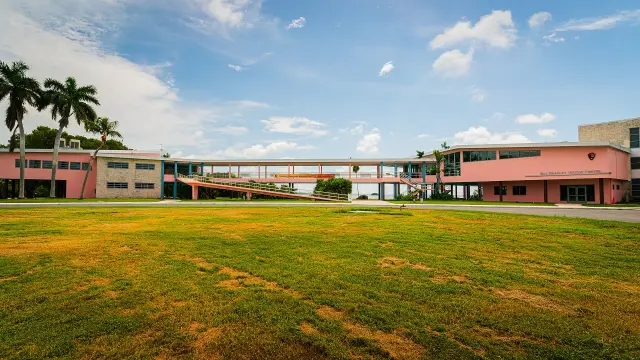
The study placed remote sensors on private and public properties in Cape Canaveral, including City Hall and the city's Water Reclamation Facility, to measure acoustic, vibration and air quality data during launches (Cape Canaveral Rocket Launch Impacts + Awareness page).
| Date | Step | Source |
|---|---|---|
| April 15, 2025 | City Council unanimously approves a launch impact study agreement with the Florida Institute of Technology (FIT) | City rocket impacts page |
| Mid-June 2025 | FIT formally withdraws under the termination clause in Section 9.0 of its contract | City rocket impacts page |
| September 2025 | New agreement executed with Rollins College to take over the study | City rocket impacts page |
| November 2025 | Active data collection begins with two sensor sites, later scaled up to five | City rocket impacts page |
| November 24, 2025 | Phase I progress report sent to city staff | City rocket impacts page |
| March 19, 2026 | Phase II progress report sent to city staff | City rocket impacts page |
| End of May 2026 | Monitoring ends and equipment is removed from all participating properties | City rocket impacts page |
| June 2026 | FIT delivers its literature review to city staff at no cost to the city | City rocket impacts page |
| June 29, 2026 | Rollins final report transmitted to city staff | City rocket impacts page |
| August 18, 2026 | Study results presented at a Regular City Council meeting | City rocket impacts page |
The original plan with FIT called for a literature review, sound level meters, accelerometers and air quality monitors in selected buildings, and data collected before, during and after each launch, with private buildings used only with written owner consent (Cape Canaveral news post on the study authorization). FIT's withdrawal letter cited concerns about the scope of the project, and the city noted at the time that no city funds had been spent (Cape Canaveral news post on the study update).
Under the Rollins College agreement, reviewed and approved by the City Attorney, the total cost to the city was set at $13,000, and the work ran in three phases (Cape Canaveral Rocket Launch Impacts + Awareness page). Across seven months of monitoring, the sensors recorded over thirty rocket launches, capturing data from Falcon 9, Vulcan-Centaur, Atlas V, SLS (the Artemis II mission), Falcon Heavy and New Glenn, plus the New Glenn hot-fire test anomaly on May 28, 2026 (Cape Canaveral Rocket Launch Impacts + Awareness page). Four landing events tied to four Falcon 9 launches were also recorded (Cape Canaveral Rocket Launch Impacts + Awareness page).
All reports and data from the program are posted for public download on the city's rocket impacts page, including the FIT literature review, the signed Rollins agreement, the Phase I, II and III reports, the results presentation, a final report handout and two launch pad distance charts (Cape Canaveral Rocket Launch Impacts + Awareness page).
What does the launch study not tell a Cape Canaveral homeowner?
The study describes community-level conditions during launches; it does not judge whether any particular Cape Canaveral building is safe or damaged (Cape Canaveral Rocket Launch Impacts + Awareness page).
The city states that the study does not assess the structural safety of any specific building, does not determine whether any building has been damaged, and makes no formal finding of regulatory compliance or non-compliance (Cape Canaveral Rocket Launch Impacts + Awareness page). Structural safety and damage questions require a site-specific engineering inspection and analysis, and compliance determinations follow each agency's own procedures, which are outside the project's scope (Cape Canaveral Rocket Launch Impacts + Awareness page).
The monitoring itself was limited in place and time: data collection began with two sensor sites in November 2025, grew to five monitoring sites with some sensors rotated between locations, and ended at the end of May 2026 (Cape Canaveral Rocket Launch Impacts + Awareness page).
Can the City of Cape Canaveral limit rocket launches?
No. Launches from KSC and CCSFS are under federal jurisdiction, and city ordinances and regulations do not apply on either property (Cape Canaveral Rocket Launch Impacts + Awareness page).
The city explains that KSC is under the jurisdiction of NASA and CCSFS is under the jurisdiction of the US Space Force, a branch of the US military (Cape Canaveral Rocket Launch Impacts + Awareness page). What the city can do is prepare: the study is meant to inform local building decisions and practices, public messaging, risk assessment and emergency management practices (Cape Canaveral Rocket Launch Impacts + Awareness page). The city says it fully supports the advancement of the space industry while preparing for the changes it brings (Cape Canaveral Rocket Launch Impacts + Awareness page).
Federal environmental reviews take public comment. In the same news post that reported FIT's withdrawal, the city encouraged residents to comment on the draft Environmental Impact Statement for proposed Starship operations at Space Launch Complex 37 (SLC-37) while that comment period was open (Cape Canaveral news post on the study update).
Which heavy-lift launch plans near Cape Canaveral went through federal review?
Two federal environmental reviews cover Starship-Super Heavy on the Cape, one for SLC-37 at CCSFS and one for Launch Complex 39A at KSC (Department of the Air Force Starship EIS website; FAA LC-39A Starship project page).
The SLC-37 review is the Department of the Air Force's, and the LC-39A review is led by the FAA. For SLC-37, the Department of the Air Force issued a Final Environmental Impact Statement (EIS) in June 2025 and a Record of Decision (ROD) in November 2025 (Department of the Air Force Starship EIS website). The ROD authorizes SpaceX to redevelop SLC-37, conduct prelaunch operations including static fire tests, and conduct up to 76 launches and 152 landings a year once the FAA completes a supplemental airspace analysis; the Air Force will finalize a revised ROD before Starship-Super Heavy launches or landings occur (Department of the Air Force Starship EIS website). Public hearings on that draft were held in July 2025 in Titusville, Cape Canaveral, Cocoa and online (Department of the Air Force Starship EIS website).
For LC-39A, the FAA Final EIS analyzes up to 44 Starship-Super Heavy launches per year, with up to 44 booster landings and up to 44 Starship landings per year (FAA LC-39A Starship project page). The FAA held two in-person public meetings on the draft in Cape Canaveral on August 28, 2025, and the comment period closed on September 29, 2025 (FAA LC-39A Starship project page). The FAA notes that finishing the environmental review does not guarantee a launch license; the license application must also meet FAA safety, risk and financial responsibility requirements (FAA LC-39A Starship project page).
The federal project pages and the City of Cape Canaveral rocket impacts page are where official updates on these reviews and the study are posted, and the City Clerk's Office at City Hall, 100 Polk Avenue, answers at 321-868-1220 (Cape Canaveral City Government page).
How can Cape Canaveral property owners reduce vibration damage risk?
The city's vibration guide says to document a property's condition, monitor and reinforce weak points, check insurance and act quickly when new damage shows (Cape Canaveral Rocket Launch Impacts + Awareness page).
The guide, posted on the rocket impacts page, is written for vibration from traffic, construction, railways and industrial equipment in general rather than for launches alone (Cape Canaveral Rocket Launch Impacts + Awareness page). The city recommends a baseline survey with photographs and video of walls, foundations, ceilings and finishes, plus a record that pipes work, water flows and toilets flush (Cape Canaveral Rocket Launch Impacts + Awareness page). A structural engineer or surveyor can prepare a dated professional condition report, which the city calls very useful if damage is later disputed (Cape Canaveral Rocket Launch Impacts + Awareness page).
Further steps on the city page include installing vibration monitoring equipment, reinforcing vulnerable elements such as cracked masonry and loose plaster, repairing existing cracks promptly because pre-existing cracks can worsen under vibration, and using flexible materials or joints during renovations (Cape Canaveral Rocket Launch Impacts + Awareness page). Owners are also told to review whether their property insurance covers vibration-related damage (Cape Canaveral Rocket Launch Impacts + Awareness page).
If damage appears, the city's advice is to document new cracks or movement immediately, notify the responsible party in writing, keep all records and get an independent assessment before repairs (Cape Canaveral Rocket Launch Impacts + Awareness page). The full list is in the city's downloadable Vibration Damage Prevention Guide (Cape Canaveral Rocket Launch Impacts + Awareness page).
Last verified: October 21, 2026, by re-reading the city's Rocket Launch Impacts + Awareness page and its two study news posts, the Department of the Air Force SLC-37 EIS site and the FAA LC-39A Starship project page.
Frequently asked questions
Who did the Cape Canaveral rocket launch impact study?
Rollins College researchers took over the study under an agreement executed in September 2025, after the Florida Institute of Technology withdrew in mid-June 2025. The total cost to the city was set at $13,000.
How many launches did the Cape Canaveral study record?
Over thirty rocket launches were recorded across seven months of monitoring, plus four landing events tied to four Falcon 9 launches.
Can Cape Canaveral stop rocket launches?
No. Kennedy Space Center is under NASA jurisdiction and Cape Canaveral Space Force Station is under the US Space Force, and city ordinances do not apply on either property.
Does the Cape Canaveral launch study show whether a house was damaged?
No. The city says the study characterizes community-level conditions and does not assess the safety of, or damage to, any specific building; that needs a site-specific engineering inspection.
Where are the Cape Canaveral launch study reports?
The city's Rocket Launch Impacts + Awareness page posts the literature review, the Rollins agreement, the Phase I, II and III reports, the results presentation and launch pad distance charts for download.
Sources
- Rocket Launch Impacts + Awareness, City of Cape Canaveral https://www.capecanaveral.gov/safety/rocket_impacts.php Used for: concerns, study history, scope, limits, tips
- Council Authorizes City-wide Rocket Launch Impact Study with Florida Tech, City of Cape Canaveral https://www.capecanaveral.gov/news_detail_T9_R359.php Used for: original scope, 2024 launch count
- Rocket Launch Monitoring Impact Study Update, City of Cape Canaveral https://www.capecanaveral.gov/news_detail_T9_R364.php Used for: FIT withdrawal, no city funds, SLC-37 comment call
- Space Force Starship EIS (Department of the Air Force) https://spaceforcestarshipeis.com/ Used for: SLC-37 Final EIS and ROD
- SpaceX Starship-Super Heavy Project at KSC LC-39A, FAA https://www.faa.gov/space/stakeholder_engagement/spacex_starship_ksc Used for: LC-39A Final EIS scope, Cape Canaveral meetings
- City Government, City of Cape Canaveral https://www.capecanaveral.gov/community_/city_government.php Used for: City Hall address and phone
Published by Rytas Dirse, Solo Founder & AI Architect
Built with AI, held to quality gates. US sources, US brands, facts only.
How this page was made
Digital Towns uses AI assistance to research and write its guides, and every page is only as good as the sources it cites. Our goal is the most accurate, useful local information possible.
If you see an error, or anything you can show is false, tell us right away and we will take a third look.
Report an error
Thank you. We'll take a third look and correct the page if it's wrong.