Short answer: The Harry T. Moore Center at 307 Blake Ave. in Cocoa is a 1924 building that the city calls the original Monroe High School campus; it was named for civil rights leader Harry T. Moore in 1954 and holds the Leon and Jewel Collins Museum of African American History and Culture, dedicated in 2017 but not yet open. The Historic Monroe Center at 705 Blake Ave. is the Monroe High School built in 1954-55, now the Children's Village.
Last verified: October 21, 2026, against the sources listed at the end of this page.
What is the Harry T. Moore Center in Cocoa?
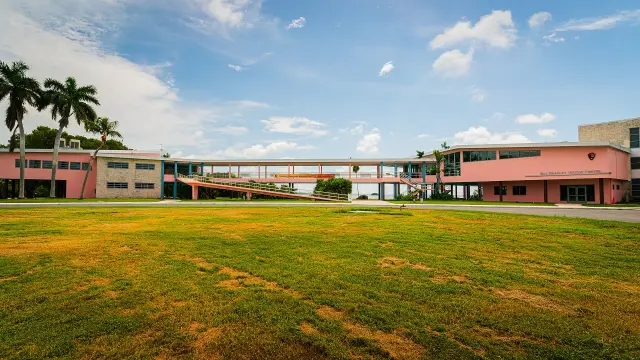
The Moore Center is a 1924 school building at 307 Blake Ave. in the Diamond Square community of Cocoa, restored by the city to house the Leon and Jewel Collins Museum of African American History and Culture (City of Cocoa museum page).
The City of Cocoa says the Harry T. Moore Center was the original campus of Monroe High School, the first all African American school in the Cocoa community, and that the building was named for Harry T. Moore, a local civil rights leader, in 1954 after Monroe High School left it (City of Cocoa museum page). The city also calls it the only African American high school still standing in Brevard County (City of Cocoa museum page).
Diamond Square, the neighborhood around the Harry T. Moore Center, is one of the two Cocoa community redevelopment areas, bounded by Pineda Street, School Street, the Florida East Coast Railroad and Rosa L. Jones Drive (Diamond Square CRA page). The 2018 Cocoa CRA plan traces the African-American community of Cocoa to the area west of Florida Avenue and the railroad, known as the Heart of Cocoa, which formed near the citrus fields and supported several black-owned businesses and two churches (2018 Cocoa CRA Plan Update).
The museum page lists parking, a playground and restrooms at the Cocoa site, and names the City of Cocoa Community Services Department, 321-433-8577, as the contact (City of Cocoa museum page).
Who was Harry T. Moore?
Harry Moore was a Brevard County educator who became a full-time civil rights activist, organized the county's first NAACP branch in 1934 and led the Florida State Conference of NAACP branches from 1941 to 1946 (Florida Division of Historical Resources marker list for Brevard County).
A state marker in Brevard County says Mr. Moore was fired for demanding equal pay and then worked to equalize the salaries of Negro teachers with those of their white counterparts, the term used on the marker; he also organized the Progressive Voters League of Florida and served as executive director of the state NAACP conference after his term as its president (Florida Division of Historical Resources marker list for Brevard County). The City of Cocoa named the Blake Avenue school building for him in 1954 (City of Cocoa museum page). State markers in Brevard County record that he and his wife, Harriette V. Moore, were killed when their home was bombed in 1951, on Christmas night by one marker's wording and on Christmas Eve by another's, and the Moore homesite guide covers that site (Florida Division of Historical Resources marker list for Brevard County).
What is the Leon and Jewel Collins Museum of African American History and Culture?
The Collins Museum is a City of Cocoa museum of African American history and culture inside the Moore Center, dedicated in 2017 and not yet open to the public (City of Cocoa museum page).
The museum carries the names of Leon and Jewel Collins, whom the City of Cocoa recognizes for their advocacy and contributions to Cocoa and Brevard County (City of Cocoa museum page). The city page says Leon Collins was the first African American elected to the Cocoa City Council, in 1973, and served ten years; Jewel Collins was the first African American woman elected to the Cocoa City Council, in 1999, and served through 2006, along with seats on the Beautification Board, the Cocoa and Diamond Square redevelopment agency boards and the Stadium Committee (City of Cocoa museum page). The couple married on January 17, 1956, marched in Cocoa for voting rights for African Americans in the 1960s, and were active in the NAACP and the Cocoa/Rockledge Civic League (City of Cocoa museum page).
On June 1, 2026, the City of Cocoa published a tribute on the passing of Jewel Collins, recalling her 1999 election, her service as Deputy Mayor and her work for the Diamond Square community, and naming the museum as the place where the Collins legacy lives on (City of Cocoa news release of June 1, 2026).
The museum is still being prepared. The City of Cocoa asks anyone with items of significance for the collection to contact the City Clerk's Office at (321) 433-8480 (City of Cocoa museum page).
How was the Moore Center building restored?
Cocoa restored the Moore Center with state help: in 2015 the city received a Division of Historical Resources Historic Preservation Small Matching Grant and a Special Category Grant for the work (City of Cocoa museum page).
The City of Cocoa page says the grants helped renovate and preserve the historic building, including roofing, flooring and an interior redesign for its future use as a museum (City of Cocoa museum page). It describes the result as a newly redesigned and restored building that is home to the future Leon and Jewel Collins Museum (City of Cocoa museum page).
The City of Cocoa CRA 2025 Annual Report says the Alliance for Neighborhood Restoration was in its 12th year of youth programs at the Harry T. Moore Center, in a partnership the Diamond Square CRA continued in fiscal year 2025 (City of Cocoa CRA 2025 Annual Report).
What is the Historic Monroe Center on Blake Avenue?
The Monroe Center at 705 Blake Ave. in Cocoa is the former Monroe High School, which a state historical marker says was built in 1954-55 as one of three segregated high schools serving Brevard County (Florida Division of Historical Resources marker list for Brevard County).
The marker says the school was named for Jessie Ruth Monroe, a pioneer, teacher and principal of Cocoa Junior High School, an earlier segregated school in the community (Florida Division of Historical Resources marker list for Brevard County). Its original address was 705 Avocado Street; the marker says the street name now honors Virgil Blake, a prominent activist in the community who lived on that street (Florida Division of Historical Resources marker list for Brevard County).
Monroe High served Black children in grades 7 through 12 from across Central Brevard until 1966-67, when area public schools were integrated, and the marker says it had a distinguished reputation as the alma mater of community leaders in education, government, industry and the arts (Florida Division of Historical Resources marker list for Brevard County). Today the Monroe Center in Cocoa is the Children's Village, with educational and social services for children and families; the Child Care Association of Brevard County, Inc. sponsored the marker with the Florida Department of State (Florida Division of Historical Resources marker list for Brevard County).
Which Cocoa building was Monroe High School, and when?
Cocoa had two Monroe High buildings: the 1924 original campus at 307 Blake Ave. and the 1954-55 school at 705 Blake Ave. (city page; state marker).
| Building | Address | Built | School use | Use today |
|---|---|---|---|---|
| Harry T. Moore Center | 307 Blake Ave. | 1924 | Original campus of Monroe High School; named for Harry T. Moore in 1954 after the school left (City of Cocoa museum page) | Future Leon and Jewel Collins Museum, not yet open (City of Cocoa museum page) |
| Historic Monroe Center | 705 Blake Ave. (originally 705 Avocado Street) | 1954-55 | Monroe High School, grades 7 through 12, until integration in 1966-67 (DHR marker, Historic Monroe Center) | Children's Village (DHR marker, Historic Monroe Center) |
| Cocoa Junior High School | Not given | Not given | Earlier segregated school led by Jessie Ruth Monroe (DHR marker, Historic Monroe Center) | Not given |
Read together, the City of Cocoa page has Monroe High School leaving the 1924 building in 1954 (City of Cocoa museum page), and the state marker has a new Monroe High School built at 705 Blake Ave. in 1954-55 (Florida Division of Historical Resources marker list for Brevard County). The sources differ on one point: the city calls the 1924 building the only African American high school still standing in Brevard County (City of Cocoa museum page), while the marker describes the 705 Blake Ave. building as the Monroe High School of 1954-55 and says the Monroe Center is now the Children's Village (Florida Division of Historical Resources marker list for Brevard County). This guide states both and does not decide between them.
Last verified: October 21, 2026, by re-reading the City of Cocoa page for the Collins Museum at the Moore Center, the city's June 1, 2026 Jewel Collins release, the Brevard County marker texts from the Florida Division of Historical Resources, the Diamond Square CRA page, the 2018 Cocoa CRA Plan Update and the CRA 2025 Annual Report.
Frequently asked questions
Is the Leon and Jewel Collins Museum in Cocoa open?
Not yet. The city's facility page for the museum gives its hours as not yet open to the public and lists Community Services at 321-433-8577 as the contact.
Who is the Harry T. Moore Center named for?
Harry T. Moore, the Brevard County teacher and civil rights leader who organized the first Brevard County NAACP branch in 1934. The City of Cocoa named the building for him in 1954.
Where was Monroe High School in Cocoa?
The City of Cocoa says the original Monroe High campus was the 1924 building at 307 Blake Ave. A state marker says Monroe High School at 705 Blake Ave. was built in 1954-55 and served grades 7 through 12 until 1966-67.
Who was Monroe High School named for?
The state marker says the school was named for Jessie Ruth Monroe, a pioneer, teacher and principal of Cocoa Junior High School, an earlier segregated school in Cocoa.
How can someone donate items to the Collins Museum?
The City of Cocoa asks people with items of significance for the museum to contact the City Clerk's Office at (321) 433-8480.
Sources
- Leon and Jewel Collins Museum of African American History and Culture at the Harry T. Moore Center, City of Cocoa https://www.cocoafl.gov/1742/Leon-and-Jewel-Collins-Museum-of-African Used for: address, status, contacts, 1924 building, 1954 naming, Collins biographies, 2015 grants
- Florida Historical Markers, Brevard County list (Florida Division of Historical Resources) https://apps.flheritage.com/markers/markers.cfm?county=brevard Used for: Historic Monroe Center marker; Harry T. Moore markers
- The City of Cocoa Honors the Life and Legacy of Jewel Collins (June 1, 2026) https://www.cocoafl.gov/CivicAlerts.aspx?AID=2188 Used for: tribute, Deputy Mayor service, museum legacy
- City of Cocoa CRA 2025 Annual Report https://www.cocoafl.gov/DocumentCenter/View/16788/2025Annual-Report Used for: ANR youth programs at the Harry T. Moore Center
- 2018 Cocoa CRA Plan Update https://cocoafl.gov/DocumentCenter/View/14684/2018-CRA-Plan-Update-FINAL-9-19-18-ADA_201908281515446311 Used for: Heart of Cocoa community history
- Diamond Square Community Redevelopment Agency (CRA), City of Cocoa https://www.cocoafl.gov/1726/Diamond-Square-Community-Redevelopment-A Used for: Diamond Square boundaries
Published by Rytas Dirse, Solo Founder & AI Architect
Built with AI, held to quality gates. US sources, US brands, facts only.
How this page was made
Digital Towns uses AI assistance to research and write its guides, and every page is only as good as the sources it cites. Our goal is the most accurate, useful local information possible.
If you see an error, or anything you can show is false, tell us right away and we will take a third look.
Report an error
Thank you. We'll take a third look and correct the page if it's wrong.