Short answer: Lift Every Voice and Sing was written in Jacksonville by two brothers born in the city: James Weldon Johnson wrote the words and John Rosamond Johnson the music, for a Lincoln's birthday celebration. A Yale University Library manuscript is dated 1900, while Florida Department of State biographies date the music to 1905. The NAACP later adopted the song, and the city keeps the brothers' LaVilla birth site at 120 Lee Street as a park.
Last verified: October 18, 2026, against the sources listed at the end of this page.
How was Lift Every Voice and Sing written in Jacksonville?
Lift Every Voice and Sing began as a Jacksonville poem by James Weldon Johnson, set to music by his younger brother, for a celebration of Abraham Lincoln's birthday.
The Yale University Library online exhibit on the song says James Weldon Johnson wrote the lyrics to commemorate the birthday of Abraham Lincoln as part of a community celebration in Jacksonville in 1900, and that John Rosamond Johnson set the words to music. The exhibit shows a manuscript version in which Johnson titles the piece National Hymn and writes that it was written for the celebration of Lincoln's birthday, Jacksonville, Florida, 1900. It also shows drafts of his autobiography, Along This Way, in which he describes writing the song with his brother.
The city connects the song to one LaVilla house. A City of Jacksonville release published by the Downtown Investment Authority on October 1, 2020, says the brothers wrote and composed the song at their home in LaVilla between 1900 and 1905, and that 120 Lee Street is their birth site. The NAACP, which later adopted the song, says it is often referred to as the Black National Anthem.
Why do official sources give different dates for the song?
The sources disagree because the Yale manuscript from Jacksonville is dated 1900, while the Florida Department of State biographies say the music was written in 1905.
| Source | What it says |
|---|---|
| Yale University Library exhibit | Manuscript titled National Hymn, written for Lincoln's birthday, Jacksonville, Florida, 1900 |
| City of Jacksonville, Downtown Investment Authority | Written and composed at the LaVilla home between 1900 and 1905 |
| Florida Department of State, James Weldon Johnson | Rosamond set to music in 1905 a poem written in 1899 |
| Florida Department of State, John Rosamond Johnson | Rosamond set to music in 1905 a poem written five years earlier |
The disagreement extends to the Jacksonville school. The Yale exhibit says James Weldon Johnson was principal of Stanton Institute from 1894 to 1902. The Department of State biography says that in 1906, at age 25, he returned to Jacksonville to become principal of the all-black Stanton School and served only a few months before a consular post in Venezuela. Both are published by institutions, and neither account of the Jacksonville years is corrected by the other; the Yale date rests on a manuscript in Johnson's own words, while the state biography gives no source for its dates.
Who were James Weldon Johnson and Rosamond Johnson?
Both brothers were born in Jacksonville, James Weldon in 1871 and John Rosamond in 1873, and both are in the Florida Artists Hall of Fame.
The Florida Artists Hall of Fame biography of James Weldon Johnson, inducted in 2000, says he enrolled at Atlanta University in 1887, founded a short-lived campus newspaper called the Daily American, and after returning to Florida in 1897 became the first African American admitted to the Florida Bar since Reconstruction. In 1901 he left Jacksonville for New York to join his brother. He later served as U.S. consul in Venezuela and, from 1909, in Nicaragua, and in 1916 became national organizer of the NAACP, where the biography counts a 14-year tenure. He took a professorship at Fisk University in 1930, died in 1938, and was honored with a U.S. Postal Service stamp in 1988.
The Hall of Fame biography of John Rosamond Johnson, inducted in 2006, calls him a native of Jacksonville and an accomplished pianist by age 4. After studying at the New England Conservatory in Boston he came back to Jacksonville and served for a time as musical director of the Bethel Baptist church. With Bob Cole he toured as Cole and Johnson and wrote and published more than 200 songs, including Under the Bamboo Tree, which sold more than 400,000 copies. He left Jacksonville for the stage, and in 1912 Oscar Hammerstein made him musical director of his Grand Opera House in London.
What was the Stanton School when the song was written?
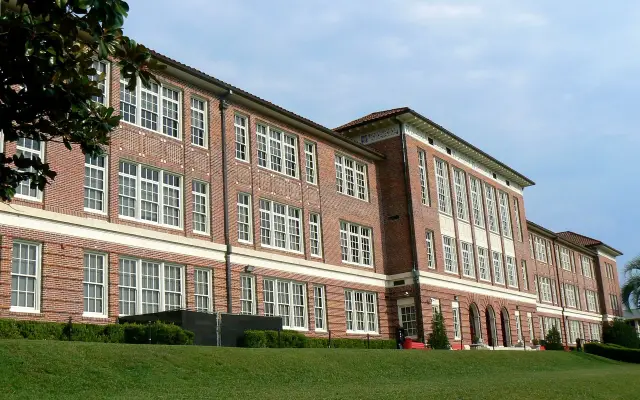
Stanton was Jacksonville's school for Black children, which the Yale exhibit says was founded in 1868, and its students were among the first to sing the song.
The Yale exhibit shows a photograph of James Weldon Johnson as principal with students at Stanton Institute around 1900 and states that students there were among the first to sing the song. It dates the school's founding to 1868, for the education of Black children.
The Department of State biography calls Stanton the city's largest public school and says Johnson changed its curriculum, installing the 9th and 10th grades with courses in English composition, algebra, literature, physics, geometry, history and Spanish. The school's own history page on the Duval County Public Schools site did not display any text when it was fetched for this check, so no district account is cited here.
How did a Jacksonville song become the Black National Anthem?
The song spread from Jacksonville through Black churches and schools and was adopted by the NAACP, which says it became a rallying cry of the civil rights movement.
The Department of State says the Jacksonville song became hugely popular among Black congregations and was being called The Negro National Anthem by the 1920s; its Rosamond Johnson biography adds that the NAACP later adopted it under that name. The Yale exhibit notes that the song became popular throughout the United States and that its sheet music was readily available.
The NAACP history page says the song was later adopted by the NAACP and prominently used as a rallying cry during the Civil Rights Movement of the 1950s and 1960s, and that it opened the 111th NAACP Convention. The Jacksonville author's link to the organization was direct: the state biography says he became its national organizer in 1916.
Where is Lift Every Voice and Sing remembered in Jacksonville today?
The city remembers the song at Lift Ev'ry Voice and Sing Park in LaVilla, on the brothers' birth site, and at James Weldon Johnson Park downtown.
Lift Ev'ry Voice and Sing Park is at 120 N Lee Street and is open from sunrise until sundown, according to the City of Jacksonville parks page. The city describes paved bands that trace the plots of the homes, businesses and yards of the once-segregated LaVilla neighborhood, where the Johnson home stood. A restored LaVilla shotgun house sits at the center inside three glass walls, with a stage projecting from its side; a lifted lawn faces it; and the north plaza holds a large sculpture spelling out the song's title in tabby concrete above a mist fountain. The sculpture Getting it Done by Brian Owens stands in the southeast corner of the garden, and the Emerald Trail runs along Lee Street on the park's eastern edge.
The 2020 design release credits the design to landscape architect Walter Hood, recalls that LaVilla was often called the Harlem of the South, and placed the park within a LaVilla Heritage Trail first proposed in a 2019 study by the Downtown Investment Authority and the Jacksonville Transportation Authority. At that time it estimated design and construction at about $2 million to $3 million and expected construction to be finished by fall 2022.
Downtown, James Weldon Johnson Park faces City Hall. The city says City Council passed bill 2020-0357-E on August 11, 2020, renaming Hemming Plaza for Johnson. The square was set aside as a public square around 1857, making it the city's oldest park; it was known as City Park and St. James Park before taking the Hemming name in 1899, and its Confederate monument was removed in June 2020. The city converted it to a brick-paved plaza in 1978 and a single-level pedestrian mall in 1986.
Last verified: October 18, 2026, by re-reading the Yale University Library exhibit, both Florida Artists Hall of Fame biographies, the NAACP history page, the 2020 Downtown Investment Authority release and the two City of Jacksonville park pages.
Frequently asked questions
Who wrote Lift Every Voice and Sing?
James Weldon Johnson wrote the words and his younger brother, John Rosamond Johnson, wrote the music. Both were born in Jacksonville, according to the Florida Department of State.
When was Lift Every Voice and Sing written?
A manuscript shown by Yale University Library is dated 1900 and says it was written for Lincoln's birthday in Jacksonville. Florida Department of State biographies instead say Rosamond set the poem to music in 1905, and a 2020 city release says between 1900 and 1905.
Where were the Johnson brothers born in Jacksonville?
The City of Jacksonville says their birth site is 120 Lee Street in LaVilla, now Lift Ev'ry Voice and Sing Park, open from sunrise to sundown.
Was Lift Every Voice and Sing first sung by Stanton students?
The Yale University Library exhibit says students at Stanton Institute in Jacksonville were among the first to sing the song. Stanton was a school for Black children founded in 1868, according to the exhibit.
Why is James Weldon Johnson Park named for him?
City Council passed bill 2020-0357-E on August 11, 2020, renaming Hemming Plaza for the author of the song. The city calls the square, across from City Hall, its oldest park.
Sources
- Lift Ev'ry Voice and Sing: Origin of the Song (Yale University Library online exhibit) https://onlineexhibits.library.yale.edu/s/lift-every-voice/page/song Used for: manuscript, 1900 date, Stanton
- James Weldon Johnson, Florida Artists Hall of Fame, Florida Department of State https://dos.fl.gov/cultural/programs/florida-artists-hall-of-fame/james-weldon-johnson/ Used for: biography, 1899 and 1905 dates
- John Rosamond Johnson, Florida Artists Hall of Fame, Florida Department of State https://dos.fl.gov/cultural/programs/florida-artists-hall-of-fame/john-rosamond-johnson/ Used for: biography, 1905 date
- Lift Every Voice and Sing, History Explained (NAACP) https://www.naacp.org/find-resources/history-explained/lift-every-voice-and-sing Used for: NAACP adoption and use (own organization)
- City of Jacksonville Unveils Design Plans for LaVilla's Lift Ev'ry Voice and Sing Park (Downtown Investment Authority, October 1, 2020) https://dia.jacksonville.gov/news/city-of-jacksonville-unveils-design-plans-for-lavilla-s-lift-ev-ry-voice-and-sing-park Used for: birth site, 1900 to 1905, design
- Lift Ev'ry Voice and Sing Park, JaxParks, City of Jacksonville https://www.jacksonville.gov/departments/parks-and-recreation/jaxparks/all-parks/lift-ev-ry-voice-and-sing-park Used for: park today
- James Weldon Johnson Park, JaxParks, City of Jacksonville https://www.jacksonville.gov/departments/parks-and-recreation/jaxparks/all-parks/james-weldon-johnson-park Used for: downtown park, 2020 renaming
How this page was made
Digital Towns uses AI assistance to research and write its guides, and every page is only as good as the sources it cites. Our goal is the most accurate, useful local information possible.
This page was fact-checked twice before publishing.
If you see an error, or anything you can show is false, tell us right away and we will take a third look.
Report an error
Thank you. We'll take a third look and correct the page if it's wrong.