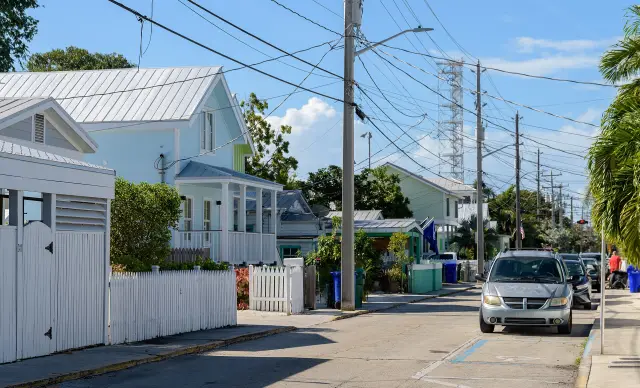
Short answer: Springfield is a National Register historic district just north of downtown Jacksonville, 119 city blocks in about 500 acres between Hogans Creek and the railroad lines. Its development began with the Springfield Company in 1882, spared by Hogans Creek during the Great Fire of 1901, it boomed in the decade after, and the district was listed on the National Register on January 22, 1987.
Last verified: October 18, 2026, against the sources listed at the end of this page.
Where is the Springfield Historic District?
The Springfield Historic District sits just north of downtown Jacksonville, roughly bounded by Twelfth, Clark and First streets, Hogans Creek and Boulevard.
That boundary is the National Park Service's National Register record for the district (NRIS 86003640). The 1987 nomination form describes Hogans Creek along the south edge, railroad lines on the north and east, and Boulevard as the western limit, where a later commercial strip abuts the older residential area. The district contains 119 city blocks in an area of approximately 500 acres, or slightly less than one square mile.
The nomination notes that the transition from downtown Jacksonville is abrupt: downtown is defined by tall commercial buildings, while north of Hogans Creek few Springfield buildings rise above two stories. The blocks are laid out in a regular grid, with named streets running north to south and numbered streets east to west, most blocks have alleys, usually in an H pattern, and a few streets keep their original brick pavers and granite curbstones. Two commercial strips, along Main and Eighth streets, join at the heart of the district.
How old is Springfield, and who developed it?
The National Register nomination finds the first documentary evidence of Springfield real estate in an 1871 circular and dates intensive development to the Springfield Company, incorporated in 1882.
An 1865 map shows little in the area except roads, the Old City Cemetery and a stockade, the nomination states, and the historian T. Frederick Davis suggested that C. L. Robinson named the area for a spring of good water in a field through which West 4th Street now passes. In 1871 land developer J. H. Norton advertised a Springfield Suburb of 300 acres with four-acre blocks, streets being graded and eight or ten houses under construction. The nomination records no founding in 1869, a year often repeated for Springfield; in the federal record the 1871 circular is the first documented date.
| Year | Event |
|---|---|
| 1871 | J. H. Norton advertises the Springfield Suburb, 300 acres |
| 1879 to 1880 | Waterworks built on 5.5 acres north of Hogans Creek |
| 1881 | Jacksonville and Fernandina Railroad marks the eastern edge |
| 1882 | Springfield Company incorporated; plat from Phelps Street to 10th Street in September |
| 1887 | Jacksonville city limits extended north to 13th Street, taking in Springfield |
| 1888 to 1891 | Springfield hosts the Sub-Tropical Exposition |
| 1898 | Camp Cuba Libre, the principal Spanish-American War camp in Jacksonville; closed January 11, 1899 |
| 1930 | End of the district's period of significance, after the Hogans Creek improvements |
Source: Springfield Historic District nomination, Section 8.
How did the Great Fire of 1901 change Springfield?
Hogans Creek acted as a natural firebreak on May 3, 1901, so Springfield was spared, and burned-out families followed the escape route north to build there.
The nomination records that the fire consumed 466 acres of Jacksonville, including 146 city blocks and 2,368 buildings, and left 9,000 people homeless. The main escape route was the Market Street Bridge over Hogans Creek into Springfield. The fire did cross the creek at one point immediately east of Main Street, where it burned a wood yard, but it was contained there.
An unprecedented building boom followed, and a December 1902 newspaper report claimed Springfield was leading the suburbs in new building. Springfield's greatest era of expansion came between 1900 and 1910, partly because the burned land south of the creek proved too valuable for rebuilding as a residential area. Only thirty buildings in the district have been conclusively identified as built before 1900, the nomination says, and contributing buildings date from about 1885 to about 1930.
What did Henry John Klutho build in Springfield?
Architect Henry John Klutho built his own Prairie School house, two apartment buildings and a film studio in Springfield between 1909 and 1916.
According to the National Register nomination, Klutho's tie to Springfield began in 1905 when he bought two lots there for $200, and he began building his residence in 1909. The house resembled Frank Lloyd Wright's Ward W. Willits house and was one of the first homes in Jacksonville to use fire-proofed asbestos shingles. In 1925 Klutho moved it from Main Street to East 9th Street, where it still stood when the district was nominated.
In 1911 he designed the Florence Court Apartments at the southeast corner of Main and 8th streets, with shops on the first floor and four three-bedroom apartments on each upper floor, and his own Klutho Apartments, next door to his residence on Main Street, were completed in 1913. Klutho also proposed a Civic Center for the Hogans Creek area between Laura, Main and 1st streets in 1913, a plan the city rejected.
Springfield had a film chapter too. By 1912 Jacksonville was known as the World's Winter Film Capital, and at least three studios were built in the neighborhood: Thanhouser Studios on East 8th Street, opened in December 1915, Victor Moore's Klever Remedies studio on East 9th Street, and Klutho's own studio, built in 1916 and sold in 1922 to Berg Productions, which closed later that year. The nomination names a young Oliver Hardy among the actors who boarded there. The NPS record lists Klutho as the district's significant name.
What is the history of Klutho Park on Hogans Creek?
Klutho Park, formerly Springfield Park, was created along Hogans Creek between 1899 and 1901 on land donated by the Springfield Company, according to the City of Jacksonville.
The City records that Jacksonville's first zoo opened at the park in 1914, followed by the first municipal swimming pool in 1922, and that the Springfield Improvement Association and Woman's Club, founded in 1904, has worked for the park's beautification. The Hogans Creek Improvement Project, designed by Klutho and engineered by Charles Imeson, turned much of the grounds into a Venetian-style promenade, and the City renamed a portion of Springfield Park in 1984 to honor Klutho.
The two official records date the parts differently. The City gives the creek project as 1929 to 1930, while the nomination says the city voted $500,000 in bonds in 1928 and approved a construction contract for the balustrades and bridges in June 1928, and it puts the Springfield Company's park gift at forty acres deeded in 1898. The nomination also records that the city acquired twenty acres along the creek in 1907 for Dignan Park, renamed Confederate Park in October 1914.
| Item | Detail | Source |
|---|---|---|
| Address | 204 West 3rd Street, Jacksonville, FL 32206 | JaxParks |
| Amenities | Baseball, basketball, golf, multipurpose field, pickleball, tennis, picnic shelters, playground, bike racks, parking | JaxParks |
| Created | 1899 to 1901 on Springfield Company land | JaxParks |
| Size in the 1987 nomination | 17.47 acres (Klutho Park); Confederate Park another 8.3 acres | NRHP nomination |
| First zoo and first city pool | 1914 and 1922 | JaxParks |
| Renamed for Klutho | 1984, a portion of Springfield Park | JaxParks |
How is the Springfield Historic District protected?
Springfield has been on the National Register of Historic Places since January 22, 1987, and the City of Jacksonville publishes Springfield-specific design guidelines and a contributing structures list for work in the district.
The nomination counted 95 percent of the district's buildings as contributing, with 98 non-contributing, and chose 1930 as the end of the period of significance, after the Hogans Creek improvements, the Florida real estate collapse of 1926 and the national economic collapse that began in 1929. It also notes that Springfield was fully developed as a residential neighborhood by the late 1920s and experienced a severe decline beginning in the 1950s, with some buildings lost to urban renewal programs of the 1950s and 1960s.
The City's Historic Preservation Section lists the Springfield Design Guidelines and the Springfield Contributing Structures List among its district resources, alongside citywide guidance on fencing, windows and new construction, ranging from window repairs and repointing to major alterations such as new construction.
The neighborhood's own preservation group is the SPAR Council, a 501(c)(3) nonprofit that says it has served as a resource and advocate for the Springfield Historic District since 1974. Its site lists signature events including the Tour of Homes, Jacksonville PorchFest and community cleanups, plus a facade grant program for businesses.
What is planned for Hogans Creek?
Groundwork Jacksonville, partnering with the City of Jacksonville, is designing a restoration of Hogans Creek that pairs stream work with the Emerald Trail and new pedestrian bridges.
On its project page, Groundwork describes Hogans Creek as a 2.6-mile tidal and freshwater creek that begins at the CSX Railroad just north of the S-Line Rail Trail and flows south to the St. Johns River at the Shipyards, and says the creek floods Klutho and Springfield parks and nearby streets during even moderate rainfall. It reports the design at 60 percent, with stream work to restore 1,300 feet of daylighted creek, and lists the Market Street, Laura Street and Klutho pedestrian bridges among the plans.
Community priorities Groundwork says it heard since 2021 from Springfield, Historic Eastside and Cathedral District residents include reducing flooding, protecting the historic park features designed by Klutho, including the balustrades, and keeping or enlarging the current open park space; its last posted community meeting was on November 5, 2025. Groundwork's own description of the finished Emerald Trail says it will connect 14 historic neighborhoods to downtown, Hogans Creek, McCoys Creek and the St. Johns River.
Last verified: October 18, 2026, by re-reading the National Park Service record and 1987 nomination for the Springfield Historic District, the JaxParks Klutho Park page, the City's historic preservation resources page, Groundwork Jacksonville's Hogans Creek and vision pages, and the SPAR Council site.
Frequently asked questions
How old is Springfield in Jacksonville?
The National Register nomination finds the first documented Springfield real estate in an 1871 circular, with major development after the Springfield Company was incorporated in 1882. That federal record does not support the often-repeated 1869 date.
When was Springfield listed on the National Register of Historic Places?
The National Park Service record for the Springfield Historic District, NRIS 86003640, shows a publication date of January 22, 1987. The district covers 119 city blocks in about 500 acres.
Why did Springfield survive the Great Fire of 1901?
Hogans Creek formed a natural firebreak on May 3, 1901. The fire crossed the creek at one point east of Main Street and was contained there, according to the National Register nomination.
Why is Klutho Park named for Henry John Klutho?
The City renamed a portion of Springfield Park in 1984 to honor Klutho, a Springfield resident who designed the Hogans Creek Improvement Project that turned the park into a Venetian-style promenade.
Where was Jacksonville's first zoo?
The City of Jacksonville says its first zoo opened in 1914 at the park now called Henry J. Klutho Park, 204 West 3rd Street, followed by the first municipal swimming pool in 1922.
Sources
- National Register nomination form: Springfield Historic District (National Park Service NPGallery, 1987) https://npgallery.nps.gov/NRHP/GetAsset/NRHP/86003640_text Used for: boundaries, 119 blocks, 500 acres, 1865 map, naming, 1871 Norton, waterworks, 1882 Springfield Company and plat, 1887 annexation, exposition, Cuba Libre, 1901 fire figures, Klutho buildings and studio, film studios, Dignan Park, 1928 bonds, park acreage, contributing counts, 1930, decline
- Springfield Historic District, NRIS 86003640 (National Park Service NPGallery) https://npgallery.nps.gov/AssetDetail/NRIS/86003640 Used for: boundary note, date published 1/22/1987, significant name Klutho
- Henry J. Klutho Park (City of Jacksonville JaxParks) https://www.jacksonville.gov/departments/parks-and-recreation/jaxparks/all-parks/henry-j-klutho-park Used for: address, amenities, 1899 to 1901, zoo 1914, pool 1922, 1904 club, 1929-30 project, 1984 renaming
- Historic Preservation Archives (City of Jacksonville Planning Department) https://www.jacksonville.gov/departments/planning-department/community-planning-division/historic-preservation-section/hp-archives Used for: Springfield Design Guidelines and Contributing Structures List
- Hogans Creek (Groundwork Jacksonville, its own project) https://www.groundworkjacksonville.org/hogans-creek/ Used for: 2.6 miles, flooding of Klutho and Springfield parks, design at 60 percent, 1,300 feet, bridges, community priorities, November 5, 2025 meeting
- Our Story (Groundwork Jacksonville, its own program) https://www.groundworkjacksonville.org/vision/ Used for: Emerald Trail to connect 14 historic neighborhoods
- SPAR Council (its own site) https://www.sparcouncil.org/ Used for: since 1974, 501(c)(3), events and facade grant
How this page was made
Digital Towns uses AI assistance to research and write its guides, and every page is only as good as the sources it cites. Our goal is the most accurate, useful local information possible.
This page was fact-checked twice before publishing.
If you see an error, or anything you can show is false, tell us right away and we will take a third look.
Report an error
Thank you. We'll take a third look and correct the page if it's wrong.