Short answer: The Indian River citrus district is the East Coast growing area, drawn through St. Lucie and Indian River counties, whose fruit alone may carry the Indian River name under Florida Statutes 601.091. The State Archives credits its reputation to a Merritt Island grove that survived the 1894 to 1895 freeze; the Indian River Citrus League formed in 1931 and Fort Pierce citrus research began in 1947. USDA credits St. Lucie County with 1,395 thousand boxes of citrus in 2025-2026.
Last verified: October 22, 2026, against the sources listed at the end of this page.
What is the Indian River citrus district?
The Indian River citrus district is the East Coast growing area that Florida law calls the Indian River production area, a strip drawn from the Flagler and Volusia line south through the Treasure Coast to the West Palm Beach Canal.
Under section 601.091, citrus grown outside that line, and any product made from it, may not be labeled or described in a way that implies it was grown in the Indian River area, unless a final court order from a proceeding begun before July 1, 1976 provides otherwise (Florida Statutes 601.091). The history note under the section starts with chapter 76-87 of the Laws of Florida and lists later amendments in chapters 77-174, 91-11 and 95-174. On the Treasure Coast the survey line turns at the southwest corner of St. Lucie County, runs east to the boundary of Range 39 East and Range 40 East, and then drops south to the south line of Martin County before reaching the canal.
An older section of the Citrus Code sorts counties another way. Section 601.09, whose history note begins with chapter 25149 of 1949, places Brevard, Indian River, Martin, Palm Beach and St. Lucie counties, along with a dozen others, in Citrus District Six, and says the Legislature intends the districts to be reviewed and, where needed to keep production substantially equal among them, redistricted every 5 years (Florida Statutes 601.09). The district list and the production area are separate sections of the Citrus Code, and the labeling rule for the Indian River name sits in section 601.091.
How did Indian River citrus earn its reputation and reach market?
The State Archives of Florida credits the great freeze of 1894 and 1895: a Merritt Island grove known as Dummett's grove came through untouched, and its survival bolstered the reputation of Indian River citrus.
The Florida Memory exhibit on the rise and fall of Florida citrus says temperatures plummeted across the state in December 1894 and again in February 1895, and that a crop of five million boxes before the freeze took almost two decades to return (Florida Memory, Bittersweet citrus exhibit). The industry moved south again after the freezes. Growers around the state then sought to use the Indian River label to tie their fruit to the Merritt Island grove's legacy, and in the 1930s and 1940s, the exhibit says, state and federal authorities defined an Indian River area and pursued retailers who sold fruit under a false Indian River claim.
The name also appears on Treasure Coast crate labels kept by the state. The State Library of Florida's crate label collection holds an Acme Brand Indian River Citrus Fruit label from a grove company in Wabasso, in Indian River County, which the library dates to the 1940s (Florida Memory crate label record).
Getting island fruit to the railroad took a bridge. The 2020 A.B. Michael (Wabasso) Bridge marker in Indian River County says a narrow wooden bridge with a metal swing span, built where a family dock had stood, let Indian River citrus travel from the Orchid Island groves to the railroad. A causeway and high-arch bridge named the Wabasso Bridge replaced it in 1970, and the crossing took the A.B. Michael name in 2020 (A.B. Michael (Wabasso) Bridge marker).
Who organized the Indian River citrus trade?
Growers and shippers organized in the 1930s, when the Indian River Citrus League formed in 1931 and the Legislature created the Florida Citrus Commission in 1935, according to the Florida Department of Citrus.
The Department of Citrus history describes the industry of the early 1930s as burgeoning but fragmented and disorganized. It lists the Indian River Citrus League and the Florida Citrus Canners Association as formed in 1931, and says the Florida Citrus Commission was officially recognized in 1935 by an act of the Florida Legislature (Florida Department of Citrus history). The Commission's first official meeting passed seventeen regulations, covering everything from the definitions of citrus fruit and packing house to grapefruit quality standards and sizes and the use of citrus tax stamps. The same timeline dates the Florida Gift Fruit Shippers to 1946 and Florida Citrus Mutual to 1948.
| Year | Milestone | Source |
|---|---|---|
| 1894 and 1895 | Great freeze; the Merritt Island grove known as Dummett's grove survives | Florida Memory |
| 1931 | Indian River Citrus League formed | Department of Citrus |
| 1935 | Florida Citrus Commission recognized by act of the Legislature | Department of Citrus |
| 1947 | Indian River Field Laboratory starts research on a St. Lucie County grove site; first Indian River Citrus Seminar | UF/IFAS IRREC |
| 1949 | St. Lucie County leases the laboratory site to the State Board of Education | UF/IFAS IRREC |
| 1949 | Chapter 25149, the first entry in the history note of section 601.09 on citrus districts | F.S. 601.09 |
| 1951 | North St. Lucie River Drainage District's 720 acre donation completed in November | UF/IFAS IRREC |
| 1970 | Causeway and high-arch Wabasso Bridge replace the wooden swing span bridge | Wabasso Bridge marker |
| July 1, 1976 | Cutoff date for court orders that override the Indian River label rule in section 601.091 | F.S. 601.091 |
How did citrus research come to Fort Pierce?
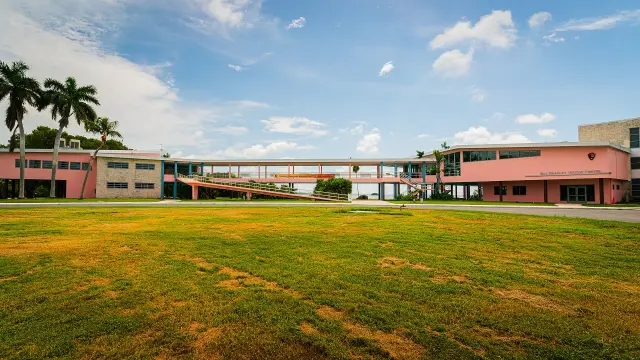
Citrus research in Fort Pierce traces to the 1947 Indian River Field Laboratory, which became a permanent station through a 1949 St. Lucie County lease and a 720 acre land donation completed in November 1951.
The center's own history says the first studies were soil surveys, water table and water salinity tests and fertility trials, and that within two years the citrus work had widened to nutritional sprays, cover crops and insect and weed control. In 1949 St. Lucie County signed a renewable lease with the State Board of Education that opened the original 80 acres to scientists based at the Lake Alfred Citrus Experiment Station. A blight that destroyed thousands of acres of Indian River tomatoes in 1948 and 1949 then led growers and Extension faculty to seek vegetable research, and the North St. Lucie River Drainage District agreed to donate 720 adjoining acres, a transfer completed in November 1951 that made room for vegetable and pasture research (UF/IFAS IRREC history).
Buildings and new names followed at the Fort Pierce site. The same history records a $62,000 air-conditioned office and laboratory building in 1960, added to an existing $20,000 greenhouse laboratory; a 1984 renaming, shared with similar UF/IFAS facilities, to Agricultural Research and Education Center; the $1.2 million, 10,000 square foot O. C. Minton Hall, dedicated in 1988; and a $3.7 million, 19,700 square foot classroom and teaching laboratory addition dedicated in 2001 (UF/IFAS IRREC history). A formal teaching program with Indian River Community College and Florida Atlantic University followed in 1998.
How much citrus does the Indian River district still grow?
In the 2025-2026 season grapefruit led the citrus crop in both Treasure Coast counties, and USDA puts the totals at 1,395 thousand boxes for St. Lucie County and 659 thousand for Indian River County.
| Type | St. Lucie County | Indian River County | Brevard County |
|---|---|---|---|
| All oranges | 629 | 90 | withheld |
| Red grapefruit | 657 | 356 | withheld |
| White grapefruit | 82 | 13 | withheld |
| All grapefruit | 739 | 369 | withheld |
| Tangerines and tangelos | 27 | 200 | none reported |
| All citrus (lemons not included) | 1,395 | 659 | 14 |
Every row comes from the USDA NASS Citrus Summary, August 27, 2026, which withholds some Brevard County figures to avoid disclosing individual operations and lists St. Lucie fourth among the five leading citrus counties it names, after Polk, Highlands and DeSoto. NASS adds that county estimates are apportioned from survey data and are not as precise as the state totals. Acreage keeps falling in St. Lucie County: the preliminary 2026 Commercial Citrus Inventory lists 17,560 acres there in 2023 and 12,741 acres with 1,904.4 thousand trees in 2026, shows Brevard County at 125 acres, gives Martin County no line of its own and reports Florida citrus acreage down 21 percent (USDA NASS Commercial Citrus Inventory, preliminary 2026).
Last verified: October 22, 2026, for the Indian River district history, by re-reading sections 601.091 and 601.09, the Florida Memory freeze exhibit and Wabasso crate label, the A.B. Michael (Wabasso) Bridge marker, the Department of Citrus timeline, the IRREC history and the two August 2026 USDA NASS citrus reports.
Frequently asked questions
What counties are in the Indian River citrus district?
The statute names no list of counties. Section 601.091 describes the Indian River production area with township and range lines, starting at the Flagler and Volusia boundary on the ocean, passing the Brevard, St. Lucie and Martin county lines and ending at the West Palm Beach Canal.
Why is Indian River citrus famous?
The State Archives of Florida says a Merritt Island grove survived the 1894 and 1895 freeze untouched, bolstering the reputation of Indian River citrus, and that growers statewide then sought to use the Indian River label.
When was the Indian River Citrus League formed?
The Florida Department of Citrus history dates the Indian River Citrus League to 1931, the same year as the Florida Citrus Canners Association and four years before the Florida Citrus Commission.
When did citrus research start in Fort Pierce?
UF/IFAS dates the Indian River Field Laboratory to 1947; a 1949 St. Lucie County lease and a 720 acre donation completed in November 1951 made it a permanent research site, today's Indian River Research and Education Center.
How much citrus does St. Lucie County grow?
USDA NASS credits St. Lucie County with 1,395 thousand boxes in the 2025-2026 season, most of it grapefruit, and its preliminary 2026 inventory counts 12,741 citrus acres in the county.
Digital Towns Market
On Digital Towns Market
 Bold Organic Extra Virgin Olive Oil (375ml) - Batch #2501$29.99
 Smooth Organic Extra Virgin Olive Oil (375ml) - Batch #2501$29.99
 Seasoning 2-Pack$15.00
 Fintastic<sup>®</sup>$8.99
 Rubs For All Set$29.99
 Pixie Dust<sup>®</sup>$8.99
 Chick Magnet<sup>®</sup>$8.99
 Sweet 'n Spicy<sup>®</sup> Sauce$8.99
Digital Towns Market is our marketplace.
Sources
- Florida Statutes 601.091 https://www.flsenate.gov/Laws/Statutes/2025/601.091 Used for: Indian River production area, history line
- Florida Statutes 601.09 https://www.flsenate.gov/Laws/Statutes/2025/601.09 Used for: Citrus District Six, 1949 origin
- Bittersweet: The Rise and Fall of the Citrus Industry in Florida, Florida Memory https://floridamemory.com/learn/exhibits/photo_exhibits/citrus/citrus2.php Used for: 1894-95 freeze, Indian River reputation, 1930s-40s area definition
- Acme Brand Indian River Citrus Fruit Label, Florida Memory https://www.floridamemory.com/items/show/342157 Used for: crate label from Wabasso
- Vero historical marker, Florida Division of Historical Resources https://markers.flheritage.com/home/details/375 Used for: railroad, drainage, Vero Beach citrus center
- A.B. Michael (Wabasso) Bridge marker, Florida Division of Historical Resources https://markers.flheritage.com/home/details/1133 Used for: Orchid Island groves to railroad
- Continued Growth, Florida Department of Citrus https://www.floridacitrus.org/?p=2947 Used for: 1931 league, 1935 commission, 1946 gift fruit shippers
- IRREC History, UF/IFAS https://irrec.ifas.ufl.edu/about-us/history/ Used for: Fort Pierce research history
- Commercial Citrus Inventory, preliminary 2026, USDA NASS https://www.nass.usda.gov/Statistics_by_State/Florida/Publications/Citrus/Commercial_Citrus_Inventory/Commercial_Citrus_Inventory_Prelim/ccipr26.pdf Used for: county acreage and trees
- Citrus Summary, August 27, 2026, USDA NASS https://www.nass.usda.gov/Statistics_by_State/Florida/Publications/Citrus/Citrus_Summary/Citrus_Summary_Prelim/cit082726.pdf Used for: 2025-2026 county production
Published by Rytas Dirse, Solo Founder & AI Architect
Built with AI, held to quality gates. US sources, US brands, facts only.
How this page was made
Digital Towns uses AI assistance to research and write its guides, and every page is only as good as the sources it cites. Our goal is the most accurate, useful local information possible.
If you see an error, or anything you can show is false, tell us right away and we will take a third look.
Report an error
Thank you. We'll take a third look and correct the page if it's wrong.