Short answer: Space Coast wildlife centers on Merritt Island National Wildlife Refuge, where Black Point Wildlife Drive is the most popular viewing route and the Haulover Canal deck shows manatees, most reliably in spring and summer. Brevard County counts 50 listed species, and its Environmentally Endangered Lands Program has helped protect more than 28,000 acres of threatened habitat across four management regions. Sea turtle nesting season runs to October 31, with county sources giving March 1 or May 1 as the start.
Last verified: October 21, 2026, against the sources listed at the end of this page.
What does the Space Coast wildlife section cover?
The Space Coast wildlife guides cover where to see manatees, birds, sea turtles and scrub animals in Brevard County, and the rules that protect them on refuge, county and water district land.
Brevard County Natural Resources explains the variety: the temperate air mass from the north meets the tropical air mass from the south here, so many species at the edge of their range live side by side, and 50 species of Brevard wildlife are classified as endangered, threatened or of special concern (Brevard County Animals and Wildlife). On federal land, Merritt Island National Wildlife Refuge, an overlay of Kennedy Space Center, helps conserve space for over 500 species of wildlife and 1000 species of plants in Central Florida and sits on the Atlantic Flyway, a major bird migration corridor (Merritt Island NWR brochure).
Guides in this section answer place questions: where a wildlife site is, when animals are present, what it costs and what is allowed there. The Haulover Canal manatee observation deck guide is the first. Closely linked guides sit in other Space Coast sections: the Merritt Island National Wildlife Refuge and Black Point Wildlife Drive guides for birds and alligators, the Canaveral National Seashore and Playalinda Beach guides for the beach side, and the Mosquito Lagoon guide for paddling and boating waters.
Where are manatees seen on the Space Coast?
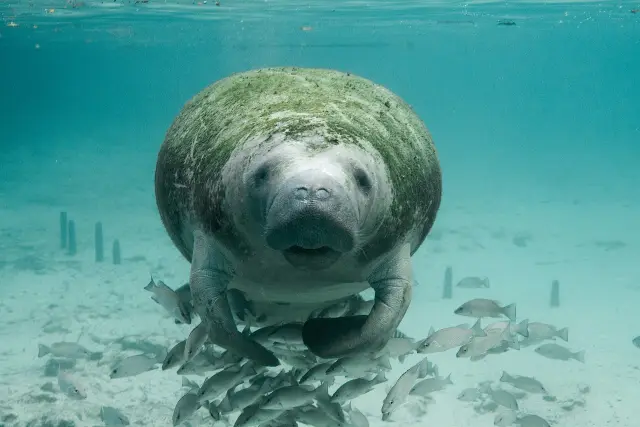
The refuge's Manatee Observation Deck at Haulover Canal is a public manatee viewing spot on the Space Coast, where manatees can be seen reliably in spring and summer when the water is warm.
The U.S. Fish and Wildlife Service describes the deck as a handicap accessible opportunity to view manatees in the wild (USFWS Merritt Island wildlife watching), and the refuge brochure places it 10.5 miles north of the refuge Visitor Center off SR 3 at Haulover Canal (Merritt Island NWR brochure). Feeding, watering, enticing or disturbing manatees, alligators and other wildlife is not permitted on the refuge.
Brevard County's wildlife page explains why manatees are common here: the Indian River Lagoon in Brevard is critical habitat for the endangered Florida manatee, a warm water refuge, seagrass beds and protected areas in the north Banana River draw them, and Brevard has been described as the hub of the east coast manatee population, with large numbers in county waters year round (Brevard County Animals and Wildlife). The county page reports spring aggregations in the north Banana River of more than 365 manatees and winter counts of at least 529 at Brevard's warm water refuges. Those counts carry no survey year on the page, and the other manatee figures in its text run from June 1974 through 1995.
Where are birds, alligators and refuge wildlife seen on the Space Coast?
Black Point Wildlife Drive, a 7 mile auto tour on Merritt Island National Wildlife Refuge, is the refuge's most popular wildlife viewing area, and its dike roads add more viewing and photography spots.
The refuge brochure puts the one-way drive on SR 406, one mile east of the SR 402 and SR 406 intersection, lists wading birds, shorebirds, raptors, waterfowl, alligators and otters among the animals seen, and says a $10.00 Refuge Daily Pass is sold on an honor system at the entrance (Merritt Island NWR brochure). The refuge also names canoe or kayak as one of the best ways to view wildlife, and says trails, towers and dike roads are especially good in fall and winter. The U.S. Fish and Wildlife Service adds that many refuge dike roads offer excellent wildlife observation and photography (USFWS Merritt Island wildlife watching).
Outside the refuge, Brevard County notes that ospreys are often seen near the Indian River Lagoon, even nesting on channel markers, and that Florida sandhill cranes live in both rural and urban areas year round (Brevard County Animals and Wildlife). The Florida scrub-jay, the only bird species entirely restricted to Florida, has a long Brevard record: the county page cites a 1993 statewide census with 374 pairs in mainland Brevard County and an estimated 850 breeding pairs on Kennedy Space Center, Merritt Island National Wildlife Refuge and Cape Canaveral Air Force Station lands, then the highest county population in the state. The page gives no newer count, though it notes recent studies in southern Brevard County documenting a decline in breeding pairs of more than 33 % since 1993.
Which Brevard County sanctuaries are open for wildlife watching?
Brevard County's Environmentally Endangered Lands Program manages sanctuaries in four regions, and its four Category 1 sites, with the most public access, are Enchanted Forest in Titusville, Pine Island in north Merritt Island, Malabar Scrub and the Barrier Island Ecosystem Center.
The EEL Program says it has helped protect more than 28,000 acres of threatened habitat since its start in 1990, much of it bought with the State of Florida and the St. Johns River Water Management District, and that Brevard voters approved up to $55 million in bonds for the purpose in September 1990 and reaffirmed the program in 2004 (Brevard EEL Program FAQs). Passive recreation on the sanctuaries can include hiking, guided nature tours, wildlife observation, canoeing and kayaking, bird watching and catch-and-release fishing, though not every activity is offered at every site, and core conservation areas such as wetlands get no trails.
| Region | Sanctuaries listed | Regional phone |
|---|---|---|
| North | Buck Lake Conservation Area, Dicerandra Scrub, Enchanted Forest, Fox Lake, Indian Mound Station, Scottsmoor Flatwoods East and West, South Lake Conservation Area | (321) 264-5185 |
| Central | Helen and Allan Cruickshank, Pine Island Conservation Area, Sams House at Pine Island, Thousand Island Conservation Area, Ulumay | (321) 449-4720 |
| South | Crane Creek, Grant Flatwoods, Jordan Scrub, Malabar Scrub, Micco Scrub | (321) 255-4466 |
| South Beaches | Barrier Island, Coconut Point, Maritime Hammock | (321) 255-4466 |
The region lists come from the county's EEL land management page, which also describes tree removal planned at Malabar Scrub Sanctuary to improve habitat for the Florida scrub-jay (Brevard EEL land management). The EEL office is at 91 East Drive, Melbourne, phone (321) 255-4466 (Brevard EEL Program FAQs). Buck Lake, on the North list, is a St. Johns River Water Management District property that the district says has 15 distinct natural community types, almost 30 miles of trails and wildlife including scrub-jays, gopher tortoises, bald eagles, otters, deer, bobcats, alligators and turkeys (SJRWMD Buck Lake Conservation Area).
When is sea turtle nesting season on the Space Coast, and what lighting rules apply?
Sea turtle nesting season on Brevard County beaches ends October 31, but two county sources give different start dates: March 1 on the county wildlife page and May 1 in the county code.
Brevard County Natural Resources calls the county's beaches some of the world's most important sea turtle nesting beaches and says nesting season in Brevard County is March 1 to October 31, when lights on houses and businesses near the beach should be turned off (Brevard County Animals and Wildlife). The county code's marine turtle protection article defines nesting season as the period from May 1 through October 31 of each year (Brevard County Code Sec. 46-91). Neither Brevard County source explains the difference.
The same Brevard County Code article says lights at parks or other public beach access points must be shielded or shaded or not used during nesting season, and limits temporary construction lighting to the minimum necessary, mounted no more than 15 feet above the ground (Brevard County Code, marine turtle protection article). For fixtures, the Florida Fish and Wildlife Conservation Commission's three golden rules of beachfront lighting are keep it low, keep it long, meaning long wavelength light of 560 nm or greater in amber, orange or red, and keep it shielded (FWC sea turtle lighting guidelines).
What wildlife rules apply on Space Coast refuge and conservation land?
On Space Coast public lands the common rule is to watch wildlife without feeding, approaching or disturbing it, and each land manager adds its own limits.
Merritt Island National Wildlife Refuge forbids feeding, watering, enticing or disturbing alligators, manatees and other wildlife, requires pets to be leashed, bans releasing animals onto the refuge and prohibits collecting animals, plants or artifacts other than legally taken fish or waterfowl; the refuge is open sunrise to sunset (Merritt Island NWR brochure). The St. Johns River Water Management District asks visitors to Buck Lake not to approach or feed any wild animal, and allows seasonal hunting, hiking, horseback riding, bicycling, fishing and primitive camping at designated sites (SJRWMD Buck Lake Conservation Area).
Brevard County asks people to watch gopher tortoises from a distance; the state lists them as a Species of Special Concern, and many other animals use their burrows in scrub and pine flatwoods (Brevard County Animals and Wildlife). EEL sanctuaries keep core conservation areas free of trails, and Category 3 sanctuaries have little or no public access development, with access limited to less fragile areas or organized EEL tours (Brevard EEL Program FAQs).
Which Space Coast wildlife guide answers which question?
Questions about one viewing site go to that site's guide, and questions about seasons, sanctuaries or lighting rules across Brevard County are answered on this page.
The Haulover Canal manatee observation deck guide covers the deck's location off SR 3, the manatee season, passes, accessibility and the boating rules around the nearby Bairs Cove ramp. The Merritt Island National Wildlife Refuge guide and the Black Point Wildlife Drive guide cover refuge birding, the auto tour and passes, which the refuge brochure sets at $10.00 per vehicle per day (Merritt Island NWR brochure). The Canaveral National Seashore and Playalinda Beach guides cover the beach district, and the Mosquito Lagoon guide covers launches and pole and troll zones on the lagoon. For county sanctuaries, the EEL Program's regional superintendents answer site questions at the numbers in the table above (Brevard EEL land management).
Last verified: October 21, 2026, by re-reading the Brevard County wildlife and EEL pages, the county code's marine turtle article, the Buck Lake page, the FWC lighting guidelines and the Merritt Island refuge wildlife page and brochure.
Frequently asked questions
Where can manatees be seen on the Space Coast?
The Manatee Observation Deck at Haulover Canal on Merritt Island National Wildlife Refuge is a public manatee viewing spot that the U.S. Fish and Wildlife Service calls handicap accessible. The refuge says manatees can be seen there reliably in spring and summer when the water is warm.
When is sea turtle nesting season in Brevard County?
Brevard County sources differ on the start: the county wildlife page says March 1 to October 31, while the county code defines nesting season as May 1 through October 31. Both end on October 31.
How many endangered species live in Brevard County?
Brevard County Natural Resources says 50 species of wildlife in the county are classified as endangered, threatened or species of special concern.
What is the Brevard EEL Program?
The Environmentally Endangered Lands Program is Brevard County's land conservation program, approved by voters in September 1990 and reaffirmed in 2004, and it has helped protect more than 28,000 acres of threatened habitat, with passive recreation such as hiking and wildlife observation on its sanctuaries.
Is there a fee to drive Black Point Wildlife Drive?
Yes. The Merritt Island refuge brochure says a $10.00 Refuge Daily Pass per vehicle is required, sold on an honor system at the drive entrance for cash or check.
Sources
- Animals and Wildlife, Brevard County Natural Resources https://www.brevardfl.gov/NaturalResources/AnimalsAndWildlife Used for: 50 listed species; sea turtle nesting season March 1 to October 31; manatee aggregations; scrub-jay 1993 census; gopher tortoise; osprey; bald eagle
- EEL Program FAQs, Brevard County https://www.brevardfl.gov/EELProgram/EELProgramFAQs Used for: 28,000 acres since 1990; 1990 referendum; Category 1 sanctuaries; passive recreation list; EEL office address and phone
- EEL Land Management and Restoration, Brevard County https://www.brevardfl.gov/EELProgram/LandManagementAndRestoration Used for: sanctuaries by region with regional phones; scrub-jay habitat work at Malabar Scrub
- Buck Lake Conservation Area, St. Johns River Water Management District https://www.sjrwmd.com/lands/recreation/buck-lake/ Used for: 15 natural community types, almost 30 miles of trails, wildlife seen, activities
- Wildlife watching at Merritt Island National Wildlife Refuge, USFWS https://www.fws.gov/refuge/merritt-island/visit-us/activities/wildlife-watching Used for: Black Point Wildlife Drive most popular viewing area; Manatee Observation Deck handicap accessible
- Merritt Island National Wildlife Refuge brochure, USFWS https://www.fws.gov/sites/default/files/documents/merritt-island-national-wildlife-refuge.pdf Used for: 500 wildlife species, Atlantic Flyway, manatee deck location and season, drive wildlife list, feeding rule, fees
- Brevard County Code ch. 46 art. III Marine Turtle Protection, Sec. 46-91 Definitions (Municode) https://api.municode.com/CodesContent?jobId=486597&productId=10473&nodeId=PTIICOOR_CH46EN_ARTIIIMATUPR_S46-91DE Used for: nesting season May 1 through October 31; park and beach access lighting rule
- Sea Turtle Lighting Guidelines, FWC https://myfwc.com/wildlifehabitats/wildlife/sea-turtle/lighting/ Used for: Keep it Low, Long (560 nm or greater) and Shielded
Published by Rytas Dirse, Solo Founder & AI Architect
Built with AI, held to quality gates. US sources, US brands, facts only.
How this page was made
Digital Towns uses AI assistance to research and write its guides, and every page is only as good as the sources it cites. Our goal is the most accurate, useful local information possible.
If you see an error, or anything you can show is false, tell us right away and we will take a third look.
Report an error
Thank you. We'll take a third look and correct the page if it's wrong.